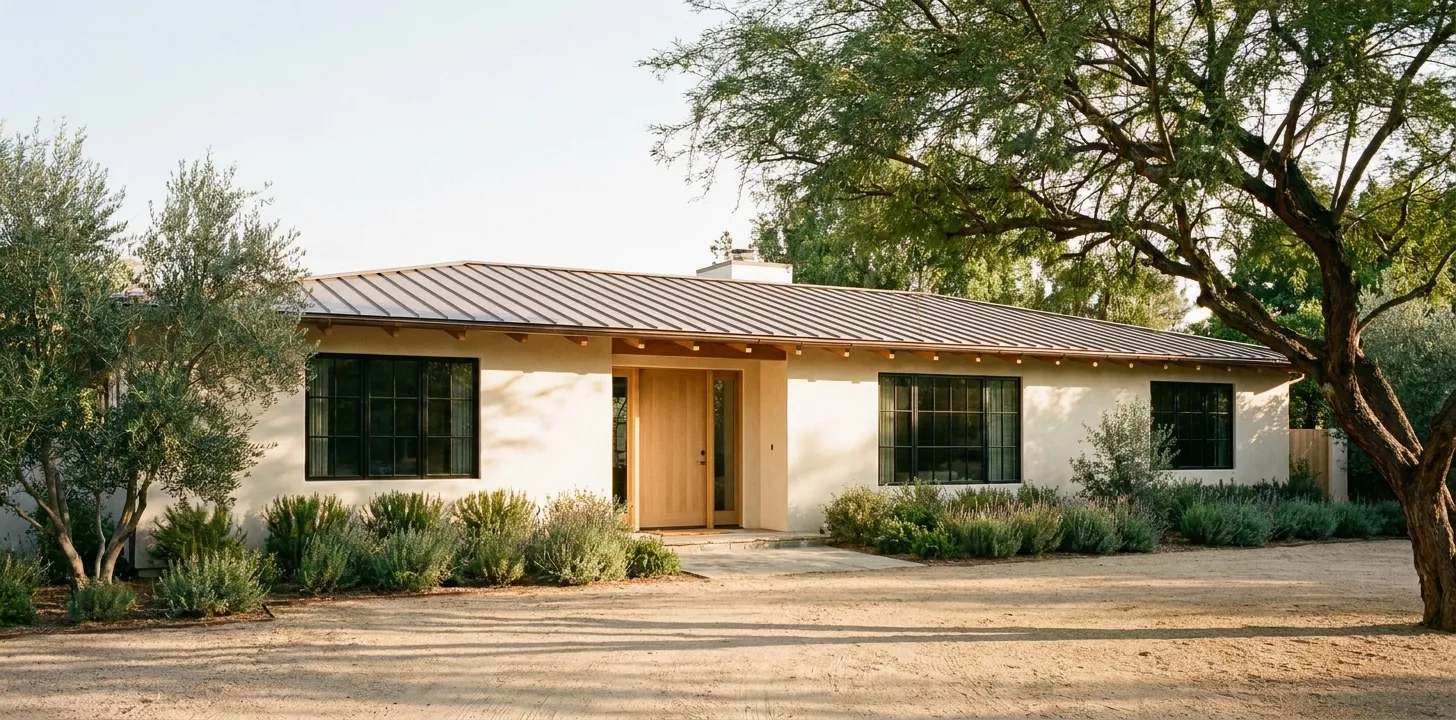
Phoenix is not Los Angeles, not Austin, not the U.S. national average. Renovating a 1955 Arcadia ranch in 2026 is its own project with its own cost structure, its own permit process, and its own set of failure modes. National renovation guides treat Phoenix as a footnote; this one treats it as the subject. Everything in this guide comes from City of Phoenix permit data, actual Phoenix contractor invoices across 70+ completed 2025 projects, the Maricopa County Assessor's comparable sales data, and the specific zoning and code variants Phoenix enforces. If you are renovating a home in Phoenix in 2026, this is the orientation.
Phoenix home renovation cost by project type — 2026 quick reference
| Project type | Cost range | Per-sqft | Timeline |
|---|---|---|---|
| Kitchen cosmetic refresh | $25K–$45K | $125–$225/sqft | 3–5 weeks |
| Kitchen midrange gut (same layout) | $85K–$140K | $425–$700/sqft | 10–14 weeks |
| Kitchen luxury gut + layout change | $160K–$280K | $800–$1,400/sqft | 16–24 weeks |
| Bathroom cosmetic refresh | $14K–$28K | $320–$680/sqft | 3–5 weeks |
| Bathroom full remodel (same layout) | $22K–$45K | $450–$850/sqft | 5–8 weeks |
| Primary bath remodel + layout change | $35K–$85K | $525–$1,050/sqft | 7–11 weeks |
| Half bath addition (powder room) | $18K–$32K | $650–$1,200/sqft | 4–6 weeks |
| Full bath addition | $32K–$58K | $580–$1,050/sqft | 6–9 weeks |
| Bedroom addition (no bath) | $50K–$140K | $255–$430/sqft | 4–6 months |
| Master suite addition | $135K–$280K | $330–$465/sqft | 6–9 months |
| Detached casita / ADU (600 sqft) | $235K–$310K | $390–$520/sqft | 8–11 months |
| Garage conversion to living space | $45K–$95K | $180–$310/sqft | 6–10 weeks |
| Garage conversion to ADU | $110K–$190K | $230–$395/sqft | 12–18 weeks |
| Carport to enclosed garage | $24K–$58K | $80–$165/sqft | 4–7 weeks |
| Whole-house cosmetic refresh (1,800 sqft) | $72K–$216K | $40–$120/sqft | 8–14 weeks |
| Whole-house mid-gut (1,800 sqft, no layout change) | $325K–$505K | $180–$280/sqft | 20–30 weeks |
| Whole-house full gut to studs (1,800 sqft) | $595K–$920K | $330–$510/sqft | 36–52 weeks |
| Second-story addition (600–1,200 sqft) | $220K–$520K | $340–$420/sqft | 10–15 months |
All-in cost including GC overhead (12%), pre-construction services, permits, and 12% contingency. Calibrated to City of Phoenix 2024–2025 permit data and ExpandEase contractor invoice tracking across 70+ Phoenix-area projects.
The five most common Phoenix home renovation project types — when each makes sense
- Master suite addition. Most common Arcadia project type. Cost $135K–$280K. ARV recovery 95%–125% — often manufactures equity. Best fit: high-equity homeowners with sub-5% mortgage who need a primary bedroom + bath but don't want to move. Full breakdown: Master Suite Addition in a 1955 Arcadia Ranch.
- Kitchen renovation. Cost $85K–$280K depending on tier. ARV recovery 65%–85% — partial recapture, more quality-of-life than wealth-generation. Best fit: homes where the existing kitchen is dated enough to suppress sale value, or where daily-life frustration is high. Full breakdown: Kitchen Renovation Cost in 2026.
- Bathroom remodel or addition. Cost $18K–$130K depending on scope. ARV recovery 40%–90% — additions recover more than remodels. Best fit: homes with single-bath inventory adding a second bath, or pre-sale renovations 12–24 months out. Full breakdowns: Bathroom Remodel Cost and Bathroom Addition Cost.
- Detached ADU / casita. Cost $235K–$415K. ARV recovery 70%–90% + rental income. Best fit: large lots with space for detached unit, owners planning rental income or multi-generational housing. Phoenix legalized ADUs by-right on most R-1 lots in 2023. Full breakdown: ADU Cost Phoenix 2026 and ADU Floor Plans.
- Whole-house renovation. Cost $72K–$920K depending on tier. ARV recovery 70%–115% — strongest at extremes (cosmetic refresh and right-sized full gut). Best fit: 1950s-era homes where the existing finishes are entirely dated and a piecemeal approach would leave the property below the neighborhood comp ceiling. Full breakdown: Whole House Renovation Cost.
Phoenix renovation cost by neighborhood / ZIP
Renovation cost varies meaningfully by Phoenix neighborhood — not because labor and materials cost more in one ZIP than another, but because the comp ceiling determines what finish level is rational, and because some neighborhoods have stricter historic-overlay or HOA constraints.
| Neighborhood / ZIP | Unrenovated $/sqft | Renovated $/sqft | Typical project size |
|---|---|---|---|
| Arcadia (85018) | $475–$520 | $680–$720 | $250K–$500K, often master suite + kitchen |
| Arcadia Lite (85016) | $420–$460 | $580–$640 | $200K–$400K |
| North Central Phoenix (85020) | $340–$390 | $480–$540 | $150K–$350K |
| Biltmore Estates (85016) | $540–$620 | $780–$850 | $350K–$700K, frequently whole-house |
| Paradise Valley (85253) | $580–$680 | $880–$1,050 | $500K–$1.5M, custom-level scope |
| Old Town Scottsdale (85251) | $420–$480 | $620–$700 | $200K–$500K |
| Camelback / South Scottsdale | $385–$440 | $540–$620 | $180K–$400K |
| Ahwatukee / Foothills | $245–$285 | $340–$390 | $100K–$250K |
| Mesa / Tempe | $215–$260 | $305–$355 | $80K–$200K |
Comp ceiling = renovated $/sqft achievable in the neighborhood based on Maricopa County recent sale data. Renovations that exceed the comp ceiling in finish-level destroy manufactured equity; renovations that land at comp ceiling capture it. For ZIP-specific cost detail, see /cost/[zip] for major Arcadia, North Central, and Paradise Valley ZIPs.
The City of Phoenix permit process — what to expect
Most Phoenix homeowners are surprised by how long the permit timeline is. Plan-review timelines have lengthened steadily since 2022 as renovation volume in the city has grown. Here is the realistic 2026 picture:
| Project type | Plan review duration | Re-submittal rate | Total typical permit time |
|---|---|---|---|
| Bathroom remodel (no layout change) | 6–10 weeks | ~25% | 8–14 weeks |
| Kitchen remodel (no layout change) | 6–12 weeks | ~30% | 8–16 weeks |
| Bathroom or kitchen with layout change | 10–14 weeks | ~40% | 12–18 weeks |
| Single-room addition | 12–18 weeks | ~35% | 14–22 weeks |
| Master suite addition | 14–20 weeks | ~40% | 16–24 weeks |
| Detached ADU (standard plan library) | 3–6 weeks | ~15% | 4–7 weeks |
| Detached ADU (custom plan) | 8–12 weeks | ~35% | 10–16 weeks |
| Whole-house renovation | 16–24 weeks | ~55% | 20–32 weeks |
| Second-story addition | 18–26 weeks | ~60% | 22–34 weeks |
Plan-review duration is the time from permit application submission to issued permit (assuming first-submittal approval). Re-submittal rate is the percentage of permits requiring at least one revision. Add 4–8 weeks for each re-submittal. The 2025 introduction of the standard plan library for ADUs reduced ADU timelines by 4–8 weeks vs. custom plans.
Phoenix-specific factors that change renovation cost vs. national averages
- HVAC sizing. Phoenix HVAC is sized at 1 ton per 500–700 conditioned sqft vs. 1 ton per 800–1,000 sqft in milder climates. Renovations that expand square footage or change layout almost always require an HVAC sizing review and frequently require equipment upgrade: $4K–$12K added to most addition projects.
- Slab plumbing. Pre-1970 Phoenix homes (most of Arcadia) have cast-iron drain lines under poured slab. If a renovation moves a fixture, the slab cut + new ABS pipe + slab patch + finish floor adds $3.5K–$7.5K per cut. Many older homes also have cast-iron at end of service life, triggering replacement requirements: $3K–$18K depending on layout.
- Asbestos and lead paint. Every pre-1978 Phoenix home may contain asbestos floor tile, asbestos pipe insulation, or lead paint. Required testing: $400–$800. Actual abatement, if found: $2,500–$22,000 depending on scope. Budget $3K of contingency for testing + minor remediation on any pre-1978 home.
- Slab thermal break. Phoenix energy code requires R-15 perimeter slab insulation on additions to mitigate summer heat gain. Most older Phoenix foundations don't have this; new additions need it. Cost: $1.5K–$3.5K added to typical addition projects.
- Exterior cladding match. Original Arcadia and Biltmore homes have specific stucco textures (Santa Barbara, smooth float) and specific tile-roof or built-up-roof systems. Generic exterior contractors produce visible mismatches that hurt resale. Specialist labor: $2–$4/sqft premium on exterior work.
- Permit fees. City of Phoenix charges approximately 2.5% of declared construction value + $1,500 base for residential renovation permits. National guides typically estimate $300–$1,200; Phoenix is meaningfully higher.
- Setback compliance. Phoenix R1-6 zoning standards (most common in Arcadia and adjacent neighborhoods): 25-foot front setback, 5-foot side setback, 25-foot rear setback, 50% maximum lot coverage, 30-foot maximum building height. Encroachments require variance applications with 8–14 week timelines and no guarantee of approval.
- Historic-overlay restrictions. Specific Arcadia subdivisions (Arcadia Proper, parts of Arcadia Heights) and Phoenix neighborhoods (downtown Roosevelt Row, Coronado Historic District, Encanto Palmcroft) have stricter restrictions on exterior changes, window styles, roof materials, and additions. Verify overlay status before committing to design fees.
The five things that go wrong in Phoenix home renovations
Based on 70+ Phoenix-area renovation projects tracked in 2024–2025, the five most common failure modes:
- Permit re-submittal cascade. A first-submittal plan that comes back with comments triggers a 4–8 week revision-and-re-submittal cycle. Multiple re-submittals (40%+ of complex projects) extend the permit clock by 12–20 weeks beyond the initial estimate. Mitigation: use experienced architects familiar with Phoenix Plan Review; pre-application meetings; standard plan library where eligible.
- Slab and structural surprises during demo. Cast-iron pipe at end-of-life, slab cracks requiring repair, undersized footings discovered when walls open up. Adds $5K–$45K per project on roughly 35% of Arcadia full guts. Mitigation: pre-demo inspection by a structural engineer + plumbing camera scope; 12%–18% contingency reserved upfront.
- Contractor pricing escalation post-permit. Contractor bid at design lock-in vs. revised bid 4–6 months later when permit issues. Material price escalation (lumber, drywall, tile, fixtures) and labor rate adjustments often shift the bid by 5%–12% during the permit timeline. Mitigation: contractor engagement at schematic design phase with material commitments locked early.
- Over-spec'd finishes that exceed comp ceiling. Homeowner specs Italian imported tile and Sub-Zero/Wolf in a neighborhood where the comp ceiling supports midrange Bosch and standard tile. Premium spend doesn't recapture in ARV. Loses $25K–$80K in manufactured equity. Mitigation: appraisal-driven finish-tier discipline; ARV-anchored design decisions.
- HOA and historic-overlay surprises. Project committed to a specific design before HOA review. HOA rejects the roof material, window style, or exterior color. Forced redesign costs 4–10 weeks and $5K–$15K in revised plans plus material restock fees. Mitigation: HOA pre-approval before architectural fees committed.
How to finance a renovation in Phoenix
Approximately 68% of outstanding Arizona mortgages carry rates below 5%; 41% carry rates below 4% — the result of the 2020–2022 rate-lock window [3]. Preserving these low rates while funding a renovation is the central financial question for most Phoenix homeowners in 2026.
Five renovation financing products are meaningfully available in Arizona in 2026. Each fits a different project profile:
- Renovation HELOC — Variable-rate line, 7.24%–7.99% (May 2026). Best for projects under $200K with strong current equity. Standard tool from Arizona credit unions.
- Standard fixed renovation loan — Lump-sum home equity loan, 7.65%–8.35% fixed. Same use case as HELOC but with rate certainty.
- ARV construction loan — Fixed during construction, 7.25%–7.625%, sized on after-repair value. Best for $200K+ projects. Structured as a second lien behind existing first mortgage, preserving low existing rate. Primary lenders: Bell Bank, Western Alliance, Arizona private banks.
- FHA 203(k) — Government-backed, replaces existing mortgage, conforming loan limit capped at $766,550 in Maricopa County in 2026. Best for lower-equity homeowners or first-time buyers of fixer-uppers.
- Fannie Mae HomeStyle — Similar to 203(k) but with higher credit standards and fewer use restrictions. Best for higher-credit borrowers doing renovation projects under $400K total cost.
For the full Arizona renovation loan comparison with rates, qualification thresholds, and decision tree by mortgage rate and project size, see Renovation Loans in Arizona and Renovation HELOC vs Renovation Loan in Arizona.
How to plan a Phoenix home renovation — the 6-month timeline
A realistic Phoenix renovation planning timeline that minimizes surprises:
| Month | Activity | Output |
|---|---|---|
| Month 1 | Site analysis, buildable area calculation, scope definition. Run cost estimates against per-sqft benchmarks. Get financing pre-qualification. | Project scope brief, budget bracket, financing path identified |
| Month 2 | Architect or design-build firm engagement. Schematic design. Contractor pre-vetting and rough bids on schematic. | Schematic design, rough contractor estimate within 10% of final |
| Month 3–4 | Design development. HOA review if applicable. Structural and MEP engineering. Final contractor selection and pricing. | Design development drawings, locked contractor bid, signed contract |
| Month 4–5 | Construction documents. Permit application submission. Pre-construction services (material ordering, long-lead items). | Issued permit, materials in production |
| Month 5–6 | Permit issued (Phoenix average 12–20 weeks from application). Demo and construction begin. | Project on-site |
Total planning timeline from project decision to demo: 5–6 months for a typical Phoenix master suite addition or kitchen renovation. Whole-house renovations and second-story additions add 1–3 months. ADU projects using the standard plan library compress to 3–4 months total planning time.
Where to start
The most common Phoenix renovation question is not "what does it cost" — it is "is this even possible on my lot." Setback constraints, lot coverage maximums, HOA rules, and historic-overlay restrictions kill an estimated 15%–20% of Arcadia renovation projects before they reach contract. Running these constraints first saves $10K–$25K in design fees on projects that would have been canceled anyway.
For homeowners who want the constraints, cost estimates, and visualization in one place before any architect engagement, the ExpandEase Reality Check produces a complete pre-design package for any Phoenix address in under 30 minutes — buildable area calculation, 2–3 layout options with 3D renderings, Phoenix-calibrated cost estimates, and ARV-based financing pre-qualification.
For the full topic library on Phoenix renovation specifically — every cost piece, every financing piece, every project-type breakdown — start at the Insights index and filter by Cost & ROI, Financing, or ADUs depending on your project type.