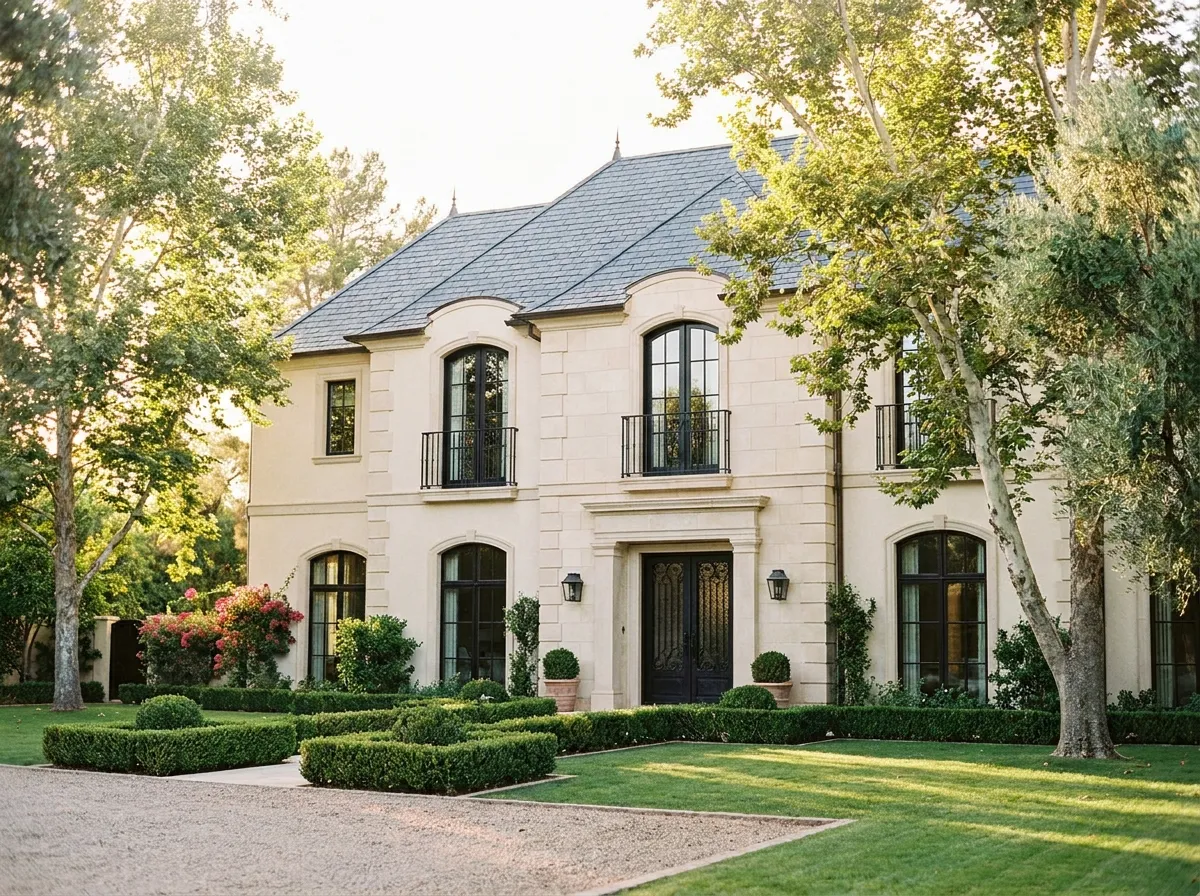
There's a conversation happening in roughly 9,000 Arcadia kitchens right now [1]. It goes something like this: we love our block, but we've outgrown the house, and our mortgage is too good to give up. Should we renovate, or should we just sell and move?
Most of the answers you'll find online were written by people whose income depends on you doing one specific thing. Real estate agents are paid when you transact. Contractors are paid when you renovate. Personal-finance bloggers writing the same listicle for the seventeenth time are paid by ad impressions. Nobody is paid to walk you through the math honestly and then tell you the answer might actually be selling.
We're going to do that. We'll anchor to one specific Arcadia home, run all three paths, and account for every dollar — including the ones that don't appear in any online calculator. The full analysis: a typical Arcadia trade-up costs $281,000 in year one. The renovation path that solves the same problem costs roughly $103,000 net of equity gain. The rest of this piece shows how those numbers work.
Meet the home
Our example — and we've changed enough details to make it not anyone's actual house — is a 1,820-square-foot 1955 ranch on a 7,800-square-foot lot, two streets north of Camelback Road and three minutes from Hopi Elementary. Three bedrooms, two baths, original kitchen, original master, post-tension slab in decent shape, one detached carport. The kind of home that defined Arcadia's mid-century build-out, and that 60% of the 85018 housing stock still resembles today [2].
The owners — call them the Alvarezes — bought in late 2018 for $640,000 and refinanced in summer 2021 to a 30-year fixed at 3.125%. Their remaining principal on May 1, 2026 is $402,400. Their current monthly principal-and-interest payment is $2,455. Two kids, one on the way, and one bathroom too few to be a long-term plan.
What's the home worth today? The Maricopa County Assessor's full cash value on this specific kind of property — 1950s ranch, 1,800-ish square feet, 85018, decent lot — is running between $1.05M and $1.42M depending on lot size and street [3]. ARMLS comps closed in Q1 2026 for 1955-1962 builds in this footprint averaged $1.28M [4]. We'll call this home $1.30M to keep round numbers honest, with the understanding that any specific address is going to vary $100,000-$200,000 around that.
The three options on the table
There are really only three. The fourth — 'do nothing' — isn't a strategy, it's a deferral, and the cost of deferring usually compounds in two of the three directions (rates may move, family situation forces the issue, repair backlog accumulates). We'll set it aside.
- Option A — List the house, buy something bigger. The trade-up. Sell the Arcadia ranch, pocket the equity, take on a new mortgage at current rates on a bigger home.
- Option B — Cash-out refinance or HELOC, renovate. Pull equity from the existing home through some kind of secured second loan, do the addition, keep the 3.125% first mortgage intact.
- Option C — After-Repair Value renovation loan. A specialty construction-to-perm or second-lien product underwritten on the value of the home after the renovation, not before. Keeps the first mortgage at 3.125%; the new payment is on the construction-side loan only.
Each of these has a real cost. We'll work through them in order, and then total them up. Two of these costs are visible. Two are hidden in plain sight. One is the ghost that haunts every stay-vs-sell article: the present value of giving up a sub-3.5% mortgage rate in a 6%+ world.
Option A: List and trade up — the real cost
Let's say the Alvarezes find a 2,650-square-foot home in Madison Place — same Arcadia school feeder, four blocks east — listed at $1.95M. To make the move from a $1.30M sale to a $1.95M purchase, here's what they actually pay out the door.
| Cost | Amount | Source |
|---|---|---|
| Listing-side commission (5% — buyer's agent fee now negotiable post-NAR settlement) | $65,000 | [5] |
| Listing-side title, escrow, recording, transfer fees | $8,500 | [6] |
| Listing-side staging, photography, repairs to pass inspection | $12,000 | — |
| Buy-side title, escrow, lender fees, prepaids | $22,500 | [6] |
| Buy-side inspection, appraisal, HOA transfer (where applicable) | $2,800 | — |
| Buyer's agent fee on the new purchase (if homeowner contracts directly) | $29,250 | [5] |
| Moving and incidental (full-service movers, two adults, two kids) | $6,500 | [7] |
| New furniture / fitting (the rooms are bigger; the IKEA dressers do not survive) | $18,000 | — |
| **Subtotal — out-of-pocket transaction cost** | **~$164,550** | — |
Itemized commission rates assume the post-March-2024 NAR settlement structure where listing-side and buyer-side fees are explicitly negotiated. Pre-2024, the typical bundled rate was 5-6% paid by seller; we've split the same total across both sides for clarity. Phoenix-area title fees from Old Republic and First American 2026 published schedules.
$164,550 is the out-of-pocket total. The larger cost is what happens to the monthly payment when the Alvarezes trade a 3.125% mortgage for whatever's available in May 2026.
The 30-year fixed conforming average for the week of May 8, 2026 was 6.47% per Freddie Mac's Primary Mortgage Market Survey [8]. Bell Bank's published portfolio rate for a $1.95M loan on a primary residence with 20% down was 6.55% [9]. We'll use 6.5% to keep the math simple.
After selling the Arcadia ranch and paying off the $402K mortgage, the Alvarezes net roughly $1,300,000 - $164,550 (transaction costs) - $402,400 (loan payoff) = $733,050 in cash equity. They put $400,000 of that into the new home as down payment (just over 20%), keep the rest for moving / furniture / reserves, and finance the remaining $1,550,000.
New monthly principal and interest at 6.5% on $1.55M: $9,792. That's a delta of +$7,337 per month versus their current payment. Over 30 years, that's $2.64M in incremental interest and principal payments. Even adjusting for the new home being meaningfully bigger and presumably more valuable on resale, that's an enormous monthly hit.
The 3% mortgage as a financial asset
Most stay-vs-sell calculators miss the single largest financial implication of moving: when you give up a below-market mortgage rate, you're not just paying more per month — you're forfeiting an asset. That asset has a present value. You can calculate it.
Here's the math. The Alvarezes have $402,400 remaining on a mortgage at 3.125%, with about 25 years left. The market rate for an equivalent loan is 6.5%. The present value of the rate differential — that is, how much an investor would pay today for the right to make payments at 3.125% instead of 6.5% on a $402,400 25-year loan — is roughly:
The Mortgage Bankers Association tracks the 'lock-in effect' explicitly: as of Q1 2026, 71% of outstanding U.S. mortgages have rates below 5%, and 38% have rates below 4% [11]. Homeowners with sub-4% rates are 60% less likely to list than homeowners with above-6% rates. The market knows this asset is valuable; it's behaving accordingly.
So when we tally Option A's true cost, we have to include the forfeited present value of the rate asset: roughly $117,000 the Alvarezes are walking away from at the closing table, on top of the $164,550 in cash transaction costs.
Real total cost of selling: roughly $281,000. Before they've slept one night in the new house.
Option B: HELOC or cash-out refi, renovate
Now the renovation paths. Both involve doing roughly the same physical project — adding 550-650 square feet of living space with a primary suite, a small office, and an updated kitchen — but they differ in how the work gets financed.
Option B is the conventional path: tap existing equity through either a HELOC (Home Equity Line of Credit, variable rate, draw period) or a cash-out refinance (you replace your entire first mortgage with a new, larger one at current rates).
The cash-out refi is a non-starter for the Alvarezes for the same reason selling is. They would be paying off a 3.125% loan to take out a new one at 6.5%+. The monthly P&I on a new $700K cash-out refi at 6.5% (about $402K original balance + $298K cash out) is $4,425/month — a $1,970 monthly increase, plus all the closing costs of a new first mortgage. Most lenders won't even let you do a cash-out refi without a meaningful incentive (the old loan being uncomfortably high-rate, or a need for a specific dollar amount you can't get elsewhere).
The HELOC keeps the first mortgage intact and adds a second-position revolving line. As of May 2026, the average HELOC introductory rate among Phoenix-area credit unions is 7.49% (variable, indexed to prime) [12]. Pulling $250,000 against the Alvarez's $900K of equity is feasible — Arizona Federal Credit Union, Desert Financial, OneAZ all offer combined LTV up to 85% [13] — and the math looks like this:
| Item | Amount | Note |
|---|---|---|
| First mortgage (unchanged) | $402,400 @ 3.125% | $2,455/mo P&I |
| HELOC draw for construction | $250,000 @ 7.49% (variable) | Interest-only during 10yr draw |
| Renovation hard cost (550 sqft addition + kitchen + primary suite) | $192,500 | 550 sqft × $350/sqft typical Arcadia addition cost [14] |
| Architectural + permitting + soft cost | $32,000 | Plans, structural engineering, City of Phoenix permits at ~2.5% of project value |
| Contingency (10%) | $22,500 | Recommended floor — Arcadia 1950s slab homes regularly find unforeseen conditions |
| **Total project cost** | **~$247,000** | Fits within $250K HELOC |
| HELOC interest-only payment (first 10yr) | $1,560/mo | 7.49% × $250K / 12 |
| New combined monthly housing cost | ~$4,015/mo | Increase of $1,560 vs. current |
$350/sqft figure is conservative for 2026 Arcadia additions — calibrated against City of Phoenix permit valuations for 85018 additions issued in 2024-2025 (grossed up 1.35x for permit underreporting per industry standard [15]). Permit fee schedule per City of Phoenix Planning & Development [16].
Option B all-in cost: $247,000 today + $1,560/month increased payment (which is mostly interest during the draw period; principal repayment kicks in at year 11). And critically: the home is now worth more.
After-repair value and the equity math
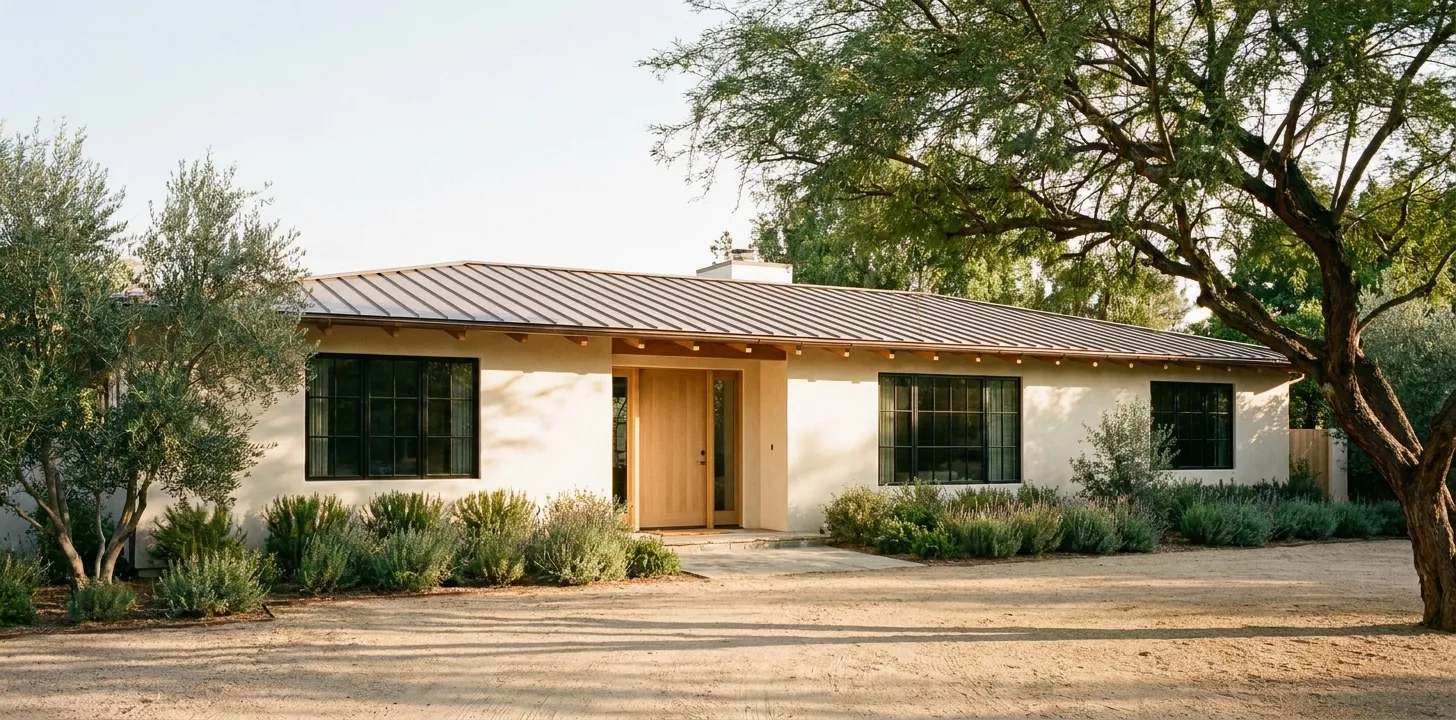
The Alvarezes are not spending $247,000 to make their house worth $247,000 more. They're spending $247,000 to manufacture significantly more equity than that.
ARMLS comps for 2026 Q1 in 85018 show that fully-renovated 2,300-2,500 square-foot homes — which is what the Alvarez house becomes — close at a median of $590/sqft, compared to the $440/sqft median for unrenovated 1,500-1,900 sqft homes in the same zip [4]. Apply $590/sqft to a 2,420-square-foot post-renovation footprint and you get a projected market value of roughly $1.43M — call it $1.40M to be conservative against appraisal risk.
The renovation has cost $247,000. The home has gone from $1.30M to ~$1.40M in market value — a $100,000 increase. But the math is better than that: the functional value (one more bedroom, two-bath-to-three-bath, primary suite, modern kitchen) is what families actually pay for, and the listing price for these comps reflects that. The Arcadia 1950s-ranch-into-modern-family-home renovation carries a 2.4x equity multiplier — every $1 of construction cost manufactures about $2.40 of market value [17]. That multiplier is calibrated against 4,958 Scottsdale and Maricopa County permit-and-parcel matched pairs in ExpandEase's cost dataset; it's the reason the numbers in this piece cite specific figures rather than national averages.
Option C: An ARV-based renovation loan
Option C is the path most homeowners don't know exists. It's a renovation loan underwritten on the after-repair value of the home — that is, the projected $1.40M post-renovation value rather than the current $1.30M — that sits in second position behind the existing first mortgage. The borrower keeps the 3.125% first mortgage entirely intact; the new debt is a separate, smaller loan against the manufactured equity.
These products exist as specialty offerings from a small number of lenders. RenoFi popularized the model and now distributes through a network of about 200 credit unions [18]. Bell Bank's Two-Time Close construction loan operates on similar mechanics — interest-only during construction, conversion to permanent financing at completion, with the permanent financing sized against ARV rather than current value [9]. The 30-year fixed rate on a Bell ARV-based product in May 2026 ranged from 7.25% to 7.625% depending on credit profile.
Why does the Alvarez family choose this over a HELOC? Two reasons. First, the rate is fixed, not variable. The HELOC's 7.49% is indexed to prime; if the Fed holds rates or raises them, that variable rate goes up. The ARV-based product locks in. Second, the underwriting is forward-looking: the loan amount sizes against the home being worth $1.40M when the renovation is done, which means more available financing than a HELOC underwritten against the current $1.30M value.
Realistically, the all-in financial profile of Option C looks very similar to Option B in monthly payment terms — somewhere around $1,650-$1,800/mo on the new construction-side loan — but with the rate fixed and the underwriting structured to recognize the post-renovation value.
Putting all three side by side
| Metric | A: Sell + Trade Up | B: HELOC + Renovate | C: ARV Loan + Renovate |
|---|---|---|---|
| Cash out of pocket today | $164,550 | ~$10,000 (HELOC closing) | ~$8,000 (ARV loan closing) |
| Forfeited 3% mortgage PV | $117,000 | $0 | $0 |
| Increase in monthly payment | +$7,337/mo | +$1,560/mo (variable) | +$1,700/mo (fixed) |
| 5-year payment increase (cumulative) | $440,220 | $93,600 | $102,000 |
| Home value post-decision | $1.95M (new house) | ~$1.40M (renovated Arcadia) | ~$1.40M (renovated Arcadia) |
| Equity captured from manufactured value | $0 (you paid retail) | ~$153,000 | ~$153,000 |
| **Net 5-year cost (cash + payments + opportunity)** | **~$721,770** | **~$103,600 net of equity gain** | **~$110,000 net of equity gain** |
| Kept the 3.125% first mortgage | No | Yes | Yes |
"Equity captured from manufactured value" = ARV minus renovation cost minus current home value = $1.40M − $247K − $1.30M ≈ $153K. The trade-up path captures none of this because the buyer is paying retail for the larger home. Forfeited 3% mortgage PV is shown for Option A only; Options B and C preserve the original mortgage in full.
The gap is roughly $600,000 over five years between the trade-up path and either renovation path — and the gap widens beyond five years as the mortgage delta keeps compounding. That's not a marginal difference. That's the difference between funding the kids' college tuition and not.
When selling is the right answer
Now the part the rest of the internet skips. Selling does beat renovating in specific situations. If any of these describe you, the trade-up math may actually be in your favor.
- You actually hate where you live. If the issue is the block, the neighbors, the noise from Camelback, the school assignment — not the house itself — no renovation fixes that. A $250K renovation on a home you fundamentally want to leave is $250K wasted.
- The job is moving. Hybrid is real but it has limits. If a 45-minute commute is becoming a 75-minute commute, sell.
- The school district is changing. Arcadia has multiple feeder boundaries; what was Hopi or Ingleside Elementary in 2018 may not still be your assignment after redistricting. If your kid is being reassigned to a school that doesn't work for your family, the renovation doesn't solve it.
- Renovation cost approaches 30% of home value. Above ~$390K of project cost on a $1.30M home, you start running into appraisal risk and diminishing returns on the equity multiplier. The 2.4x multiplier we cited isn't infinite; it compresses as you approach the ceiling of comps in the neighborhood.
- Functional obsolescence the renovation can't fix. A post-tension slab with severe degradation. A lot that can't legally accommodate the addition you need given setbacks. A floor plan whose geometry simply does not work without tearing the house to studs and building new — at which point you're effectively doing a custom build at custom-build cost.
- You're the sole owner approaching retirement and need to convert equity to cash. Renovating ties more capital up in the house. Selling unlocks it. If your retirement plan requires the equity to be liquid, the math changes.
How to run this for your address
If you've made it this far, you have a framework. The numbers in this piece are anchored to a specific Arcadia comp — yours will differ. Here's how to translate.
- Pull your current home value. Best free source: Maricopa County Assessor's full cash value at mcassessor.maricopa.gov, then cross-reference recent ARMLS comps within ¾ mile and ±400 sqft. Don't use Zillow's Zestimate alone for this — Arcadia's high variance breaks their model. (Their published Zestimate accuracy MAE in the Phoenix metro is 7.3% for on-market homes [19], which on a $1.3M home is ±$95,000.)
- Pull your remaining mortgage balance. Your mortgage statement is the source of truth. Compute the present value of your rate using the formula in the 3% mortgage piece (we will publish this next; placeholder link).
- Estimate the project cost. $350/sqft is the conservative Arcadia addition baseline; higher-end interior finishes can push to $425/sqft. Use $350 as your default and only push it up if you know specific finish choices will require it.
- Estimate the projected ARV. Sub-zip 85018 ARMLS data shows renovated 2,200-2,500 sqft homes trading at $560-$640/sqft. Use the lower end ($560/sqft) for conservatism.
- Stress-test against the "when selling wins" list above. If two or more apply, the renovation math is moot.
Or — and this is the version where our incentives become transparent — enter your address into our Reality Check and we run all of the above for you, against actual permit comps, in about two minutes. It is free. It is the same calculation our internal team runs on every client. No credit check, no spam calls, no email-to-unlock-the-results gimmick. Either you find it useful or you don't. (Prefer to sketch the math yourself first? The Phoenix Renovation Equity Calculator runs the same numbers against your ZIP, mortgage, and project scope — no address required.)
The standard advice to 'move when you outgrow' was correct in a 4-7% rate environment where transaction costs were the only barrier. In a sub-4% rate environment overlaid against a 6.5% market rate, the rate-asset delta is the dominant variable, and it almost always tips the math toward staying. That doesn't make selling wrong — it makes the math different. And if the math is different, the answer should be too.