The standard process for designing a home addition in Phoenix is: meet with an architect, pay $2K–$5K for schematic design, discover a setback or structural issue that kills the plan, revise, pay $3K–$8K for design development, discover a budget mismatch, revise, pay another $4K–$10K for construction documents, send to a contractor for pricing, discover the contractor's bid is 60% above the budget assumption, revise everything. By the time the homeowner has a buildable plan, they've spent $9K–$23K on design fees and 6–10 months of calendar time. Most of that spend was avoidable. This guide walks through the seven steps to do upfront — before any design fees are committed — so the architect engagement starts with a buildable scope, a budget that matches the design, and zero surprises in plan review.
Step 1: Site analysis — define the buildable area
Every home addition starts with the same question: where on the lot can the addition physically go? The answer is determined by setback requirements (Phoenix R1-6 zoning standards), existing structures (main house, garage, pool, casita, utility shed), and easements (utility, drainage, sometimes scenic).
- Pull a current property survey. Maricopa County GIS provides parcel maps with lot lines and dimensions [1]. If the home was built post-1990, the original recorded survey is on file with the county. For older homes, a new survey may be needed ($800–$1,500).
- Mark setback minimums. R1-6 (the most common Arcadia zoning) requires: 25-foot front setback, 5-foot side setback, 25-foot rear setback, 50% maximum lot coverage, 30-foot building height limit [2]. Some Arcadia historic-overlay districts have stricter setbacks — verify zoning before designing.
- Identify easements. APS utility lines, City of Phoenix sewer mains, monsoon drainage easements, and scenic easements all restrict buildable area. Easements are recorded on the title document or visible in Maricopa County GIS.
- Calculate current lot coverage. Sum the footprint of the main house + garage + casita + pool deck + any covered patios. R1-6 allows 50% of lot area as building footprint. On a 9,000-sqft lot, that's 4,500 sqft. If the existing structures cover 3,200 sqft, the maximum addition footprint is 1,300 sqft. This number is often surprising and immediately constrains design.
Step 2: Identify your existing home's constraints
The existing home determines what addition is structurally feasible. Four variables to identify before design:
- Foundation type and condition. Post-tension slab (common in 1960s+ Phoenix homes) makes any plumbing or structural cut into the existing slab significantly more expensive — $4K–$12K per cut. Conventional reinforced slab (most 1950s Arcadia) is easier to modify. Slab condition (cracks, settling, moisture intrusion) may require repair work before any addition can be permitted.
- Roof structure type. Trussed roofs (common in homes built after 1965) limit second-story addition feasibility because the entire roof structure must typically be replaced. Stick-framed roofs (common in 1950s Arcadia ranches) allow easier second-story or attic-conversion additions. Roof age also matters — additions during the natural roof replacement cycle save $18K–$32K in coordination.
- Electrical service capacity. Original Arcadia main service was typically 100A; modern code requires 200A+ for any home with electric appliances and HVAC. Service upgrade cost: $4.5K–$9.5K. Additions typically trigger the need for a service upgrade if not already done.
- HVAC capacity. Phoenix HVAC systems are sized at 1 ton per 500–700 conditioned sqft. Adding 400 sqft typically requires either extending the existing system (if it has spare capacity, often it doesn't) or installing a dedicated mini-split for the new space. A Manual J load calculation by an HVAC engineer ($400–$800) confirms which path applies.
Step 3: Define the addition's functional purpose
Functional purpose drives floor plan layout, which drives cost. The four most common Arcadia addition purposes have distinct design implications:
| Purpose | Floor plan implication | Cost implication | ARV implication |
|---|---|---|---|
| Add a primary suite | Connect to existing master bedroom or replace it. Layout includes bedroom + ensuite bath + walk-in closet. | $135K–$220K for 400–550 sqft addition | 95%–125% recovery; ARV-positive in Arcadia |
| Add a kitchen/family great room | Connect to existing kitchen, often opens up existing kitchen-living wall. Layout includes kitchen extension + family room + dining. | $145K–$320K for 350–500 sqft | 70%–95% recovery; ARV-neutral to ARV-positive |
| Add a guest suite / in-law unit | Detached structure or attached suite with separate entrance. Layout includes bedroom + bath + small kitchen / kitchenette + living area. | $220K–$415K detached or $180K–$280K attached | 70%–90% recovery; rental income potential |
| Add a home office / workout room | Standalone room, often without plumbing. Connect to main living area or via dedicated entrance. | $40K–$110K depending on size and finish | 50%–75% recovery; quality-of-life primary |
For the full home addition cost breakdown by type, see /insights/home-addition-cost-2026.
Step 4: Sketch 3-4 floor plan options before committing
Most architects start with their preferred floor plan and develop it. Most homeowners arrive with no specific plan and accept the first option presented. Both are mistakes. The cheapest place to explore floor plan options is on a piece of paper — sketches that compare 3–4 layout options take 4–6 hours of homeowner time and cost nothing. The expensive place to explore options is at design development, where each variation costs $2K–$5K in revised drawings.
For a master suite addition, sketch options should typically include:
- Linear extension off existing master bedroom. Cheapest construction. Bedroom goes from existing to new addition. Existing master bath stays or becomes the closet for the new master.
- T-shape addition behind the existing master. Bedroom in main wing, bathroom and closet in the perpendicular wing. Often allows more privacy from the rest of the house.
- Side-wing addition with new circulation. Master suite is its own wing accessed through a new hallway. Most architecturally satisfying but most expensive.
- Convert existing room + add what was lost. Existing master becomes the new closet/bath; new addition is the new master bedroom. Often the cheapest option when existing bedrooms are well-located but small.
For our specific approach to visualizing these options before any design fees are spent, see the ExpandEase Reality Check tool — it produces visual scope walkthroughs and cost estimates for multiple layout options in 24 hours, before any architect engagement.
Step 5: Set a real budget against real costs
Most addition projects fail not because the design is bad but because the design exceeds the budget. The standard sequence — design first, price later — guarantees a 30%–60% gap between the design and the budget by the time pricing happens. The right sequence is to set a real budget against real cost benchmarks first, then design to it.
For Phoenix in 2026, the relevant per-sqft benchmarks by addition type (see home addition cost guide for full detail):
- Master suite addition: $330–$465/sqft all-in
- Kitchen extension / great room: $420–$640/sqft
- Detached casita / ADU: $415–$520/sqft
- Garage conversion (to living space): $180–$310/sqft
- Sunroom (3-season or 4-season): $170–$280/sqft
- Second-story addition: $340–$420/sqft
Multiply your target addition footprint by the appropriate $/sqft midpoint. Add 15% if the addition includes plumbing-heavy elements (master suite with elaborate bath, kitchen extension, casita). Add 12% contingency on top. The result is your buildable budget — the cost the design should be sized to, not the other way around.
Step 6: Check architectural style match
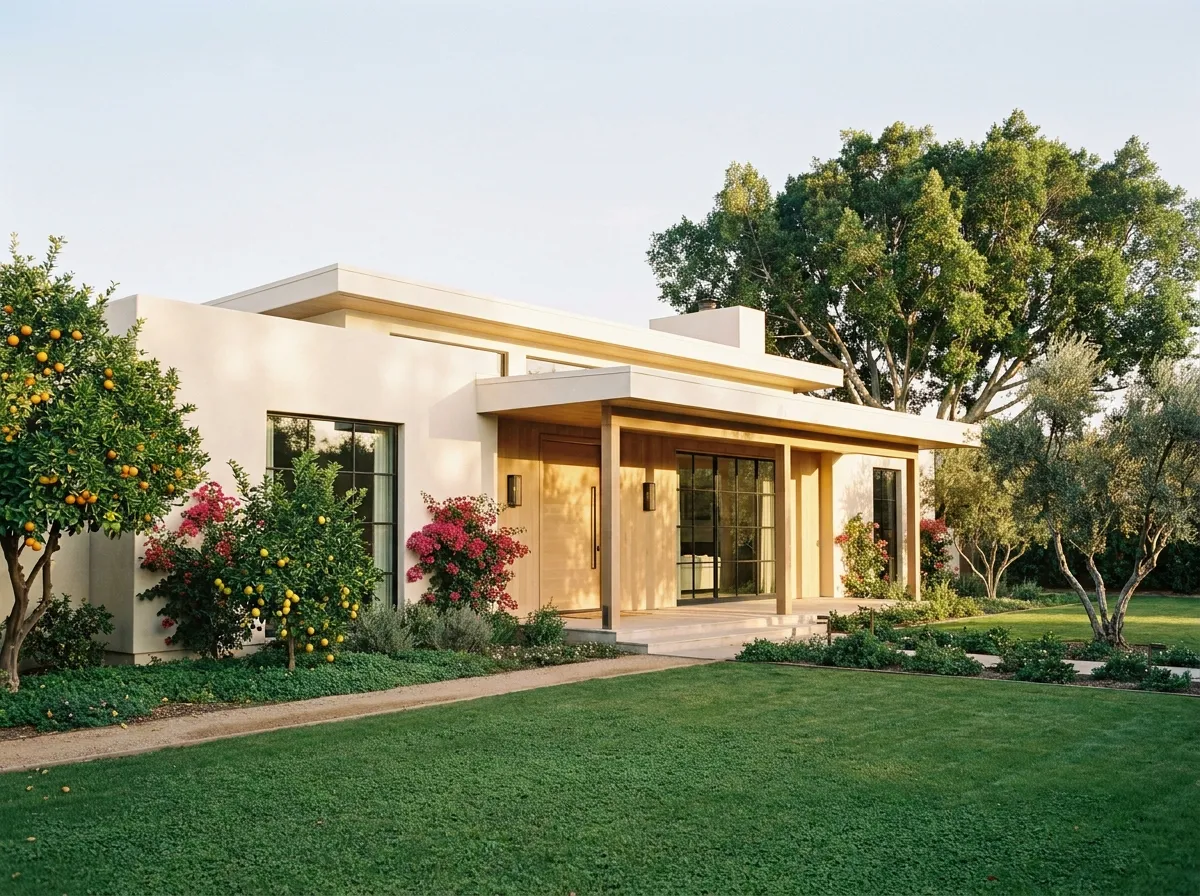
Arcadia's original housing stock is overwhelmingly 1950s single-story ranch — low-pitch hip roofs, exposed wood beams in some, clipped gables in others, white or sand-toned stucco walls, simple trim. Additions that don't respect this style read as obvious additions and reduce the property's overall perceived value. Additions that match the existing style are typically invisible to anyone who didn't see the home before the work.
Key style considerations for Arcadia additions:
- Roof pitch. Match the existing pitch within 2 degrees. Original Arcadia hip roofs are typically 4:12 or 5:12 pitch. Adding a 12:12 pitched gable to an existing 4:12 hipped roof creates a visual disconnect.
- Eave overhang. Original ranches have 24"–36" overhangs. Generic builder-spec additions often have 12"–18" overhangs. Match the existing overhang or the addition reads as out of place from the street.
- Window proportions. Original Arcadia ranches have horizontal-emphasis windows (wider than tall) at consistent head height. Some 2026 additions install vertical-emphasis windows that don't match. Match the existing proportion or expect a visual mismatch.
- Trim and stucco texture. Original Arcadia stucco is typically smooth float or Santa Barbara texture (a specific medium-coarse finish). Generic stucco contractors produce different textures. Specialist labor is required for clean match: $2–$4/sqft premium.
- Material continuity at the joint. Where the new addition meets the existing structure, the joint detail must be considered. Brick course continuity, stucco joint placement, roof shingle continuity — all matter visually and structurally.
Step 7: Stage the permits and contractor selection
The permit and contractor selection sequence determines how the project actually unfolds. Two paths are common in Phoenix:
- Path A: Design-bid-build. Architect produces complete plans, plans go through City of Phoenix Plan Review (12–18 weeks), bidding to 3–4 GCs (3–5 weeks), contract awarded, construction begins. Pros: GCs bid on identical scope, easy to compare prices. Cons: long calendar time, design lock-in before pricing, no GC input on cost engineering.
- Path B: Design-build with GC engaged early. GC engaged at schematic design stage to provide real-time cost feedback. Plans developed in collaboration with the GC, who can flag cost drivers and propose value-engineering alternatives during design. Plans go to permit and construction with the engaged GC. Pros: faster, fewer surprises, no bidding war. Cons: less price competition, requires GC vetting upfront.
For most Arcadia additions in the $200K–$600K range, design-build is the better path. The lost price competition is more than offset by the cost engineering and the calendar acceleration. ExpandEase's standard model is a design-build approach — see our Golden Record process for how the design and GC engagement integrate.
A planning timeline that respects the calendar reality
A realistic planning timeline for a Phoenix master suite addition that follows all 7 steps:
| Phase | Duration | Cost | Output |
|---|---|---|---|
| Step 1–4 (homeowner pre-design) | 3–6 weeks | $0–$800 (survey if needed) | Buildable area + functional purpose + sketched layouts + initial budget |
| Architect engagement: schematic design | 4–6 weeks | $3K–$6K | Refined floor plan, exterior elevations |
| Architect: design development | 6–8 weeks | $4K–$8K | Detailed floor plan, MEP layout, structural notes |
| Architect: construction documents | 4–6 weeks | $6K–$12K | Complete plan set ready for permit and construction |
| Plan review (City of Phoenix) | 12–18 weeks | $2K–$5K (permit fees) | Issued permit |
| Construction | 6–9 months | $135K–$280K (project cost) | Completed addition |
Total typical calendar time from pre-design start to certificate of occupancy: 13–16 months. Total design fees and permits: $15K–$30K. Project cost is separate and depends on scope and finish tier.
Common Phoenix home addition design mistakes
- Designing before the buildable area is known. Most common mistake. Discovering a setback or easement issue after schematic design costs $3K–$8K in revised drawings and 4–8 weeks of calendar time.
- Over-glazing for Phoenix climate. Adding floor-to-ceiling west-facing or south-facing glass to an addition without sufficient overhang creates a heat-gain problem that HVAC has to absorb. Specify shade structures, deep overhangs (3'+), or low-SHGC glass on west and south exposures.
- Skipping the contractor cost-check before construction documents. $20K–$40K in design fees can be spent producing a plan a contractor immediately tells you costs 50% more than budgeted. Engage a GC at schematic design stage for cost-engineering input.
- Choosing aesthetic over function on a single-shot decision. A primary suite addition is a 5–10 year decision (or 20–30 year). The aesthetic preferences that drive every-3-year furniture replacement shouldn't drive a once-per-decade floor plan. Stress-test the layout against 5-year and 10-year scenarios.
- Ignoring resale impact for a personal-use renovation. Even if you're not planning to sell, the renovation's impact on resale value is real money. A primary suite addition that exceeds the neighborhood comp ceiling for finish quality manufactures negative equity. Design to the comp ceiling, not to your Pinterest board.
How ExpandEase changes the standard process
The seven-step process above is the right sequence for any Phoenix home addition, but it requires meaningful upfront homeowner work — typically 20–40 hours of research, sketching, budget-setting, and contractor pre-vetting before any design fees are committed. ExpandEase's Reality Check tool compresses that work into a 30-minute interaction by:
- Pulling the buildable area calculation automatically from your address
- Mapping the typical Arcadia addition options to your specific lot geometry
- Generating visual scope walkthroughs (3D-rendered) for 2–3 layout options
- Producing a Phoenix-calibrated cost estimate for each option, with line-item breakdown
- Pre-vetting against the City of Phoenix standard plan library and historic-overlay constraints
- Connecting to ARV-based financing pre-qualification
For homeowners who would otherwise spend 20–40 hours doing this analysis themselves, or $15K–$25K paying an architect to discover the same constraints, the Reality Check is the right entry point. Start your Reality Check — produces a complete pre-design package for any Phoenix address in under 30 minutes.