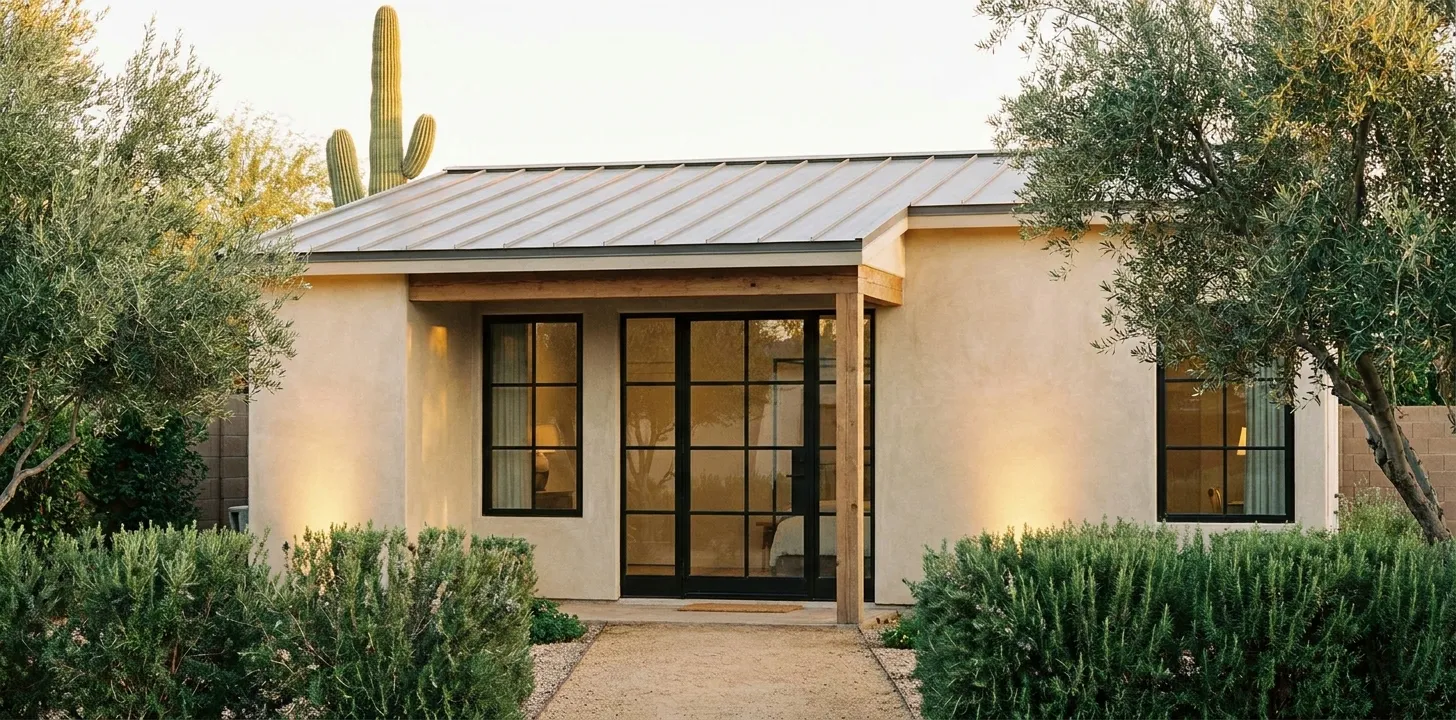
Garage conversions occupy a strange place in the renovation market: they share the words "addition" and "conversion" with much more expensive projects, but the actual cost is a fraction of new construction because the foundation, walls, and roof already exist. The trade-off is appraisal — converted square footage doesn't count the same as purpose-built additions in most comp analyses. This piece breaks garage conversions into the three projects that actually exist (conversion to conditioned living space, conversion to a full ADU with kitchen and bath, and the inverse — upgrading an existing carport to an enclosed garage), with real Phoenix 2026 costs for each.
The three garage conversion projects — what each one includes
| Project | Scope | Cost (Phoenix 2026) | Timeline | ARV recovery |
|---|---|---|---|---|
| Garage → living space (bedroom, office, family room) | Insulation, drywall, flooring, HVAC extension, basic electrical, window replacement, exterior door swap, finish work. No plumbing. | $45K–$95K | 6–10 weeks | 60%–80% |
| Garage → ADU (full living unit) | All of the above + plumbing for kitchen and bathroom, kitchen rough-in, full bathroom, separate entrance, dedicated HVAC, electrical upgrade with subpanel. | $110K–$190K | 12–18 weeks | 70%–90% + rental income |
| Carport → enclosed garage | Foundation extension if needed, perimeter walls, roof replacement or extension, garage door, electrical, drywall (interior side). | $24K–$58K | 4–7 weeks | 70%–95% |
All-in cost including GC overhead, pre-construction services, permits, and contingency. Assumes existing detached or attached garage / carport structure is in serviceable condition; significant structural repair adds $8K–$25K.
Garage to living space (bedroom, office, family room): $45K–$95K
Converting a 2-car garage (typically 400–550 sqft) to a conditioned living space — bedroom, home office, family room, or workout room — runs $45K–$95K all-in in Phoenix in 2026 at $180–$310/sqft. The wide range is driven primarily by HVAC complexity and window/door scope.
| Line item | Cost | % of total |
|---|---|---|
| Insulation (walls, ceiling, slab edge) | $3,800 | 5.6% |
| Drywall, taping, paint | $5,400 | 7.9% |
| Flooring (engineered hardwood or LVP) | $5,200 | 7.6% |
| HVAC extension (mini-split or duct extension) | $6,500 | 9.6% |
| Electrical (outlets, switches, light fixtures) | $3,200 | 4.7% |
| Garage door replacement (with French doors or wall + window) | $8,800 | 12.9% |
| Window upgrades (2 new windows, code-compliant egress) | $4,200 | 6.2% |
| Slab leveling / moisture barrier (if needed) | $3,500 | 5.1% |
| Trim, paint, interior finish carpentry | $4,800 | 7.1% |
| Door (exterior swap to residential) | $2,200 | 3.2% |
| Labor (general, install) | $8,200 | 12.1% |
| GC overhead (12%) | $6,400 | 9.4% |
| Permits, design, contingency | $5,800 | 8.5% |
Representative composition from a 2025 Arcadia garage-to-bedroom conversion. Total all-in: $68,000.
The single largest cost driver in a garage-to-living-space conversion is HVAC. Extending the home's existing duct system into the converted space is the cheapest path ($3K–$5K) but requires that the existing HVAC has spare capacity — which most 1950s Arcadia systems don't. The alternative is a dedicated mini-split system ($4,500–$8,500), which is independent of the main HVAC but adds permanent equipment and a permit requirement.
Garage to ADU (full living unit): $110K–$190K
Converting a garage into a complete accessory dwelling unit — kitchen, bathroom, separate entrance, dedicated HVAC, full code-compliant living space — runs $110K–$190K all-in in Phoenix in 2026 at $230–$395/sqft. The cost is roughly double the living-space-only conversion because of plumbing density (full kitchen + bathroom + drainage tie-in) and electrical upgrade (most original garages have one or two 15-amp circuits; an ADU typically requires a 60-amp subpanel or new service drop).
The City of Phoenix ADU ordinance update of 2023 made garage-to-ADU conversions notably easier — many garage conversions can now be permitted by-right on R-1 lots without zoning variances [1]. The standard plan library introduced in 2025 includes pre-approved garage conversion templates that reduce design fees by $3K–$6K vs. custom plans.
ARV recovery on a garage-to-ADU conversion is meaningfully stronger than a living-space-only conversion because the ADU triggers a separate appraisal treatment — the appraiser values the unit as an income-producing accessory rather than discounted secondary space. Combined with rental income of $1,500–$2,000/month for a 1-bedroom Arcadia ADU [2], the unit is often cash-flow positive from month one.
Carport to enclosed garage: $24K–$58K
Many Arcadia ranches built 1950–1965 have carports rather than enclosed garages. Upgrading a carport to a real enclosed garage runs $24K–$58K all-in in Phoenix in 2026, depending on whether the carport already has a slab and a roof of suitable structural quality.
| Line item | Cost | % of total |
|---|---|---|
| Foundation work (perimeter footings, slab extension if needed) | $5,500 | 13.1% |
| Wall framing (3 sides + back wall) | $6,200 | 14.8% |
| Roof tie-in or replacement | $4,400 | 10.5% |
| Garage door (16-foot, insulated, with opener) | $3,800 | 9.0% |
| Side service door | $1,400 | 3.3% |
| Exterior cladding (stucco to match home) | $5,800 | 13.8% |
| Electrical (220V for opener, lighting, outlets) | $3,500 | 8.3% |
| Interior drywall + paint | $3,200 | 7.6% |
| Labor (general, install) | $3,800 | 9.0% |
| GC overhead (12%) | $4,000 | 9.5% |
| Permits, contingency | $3,400 | 8.1% |
Representative composition from a 2025 Arcadia carport-to-garage upgrade. Total all-in: $42,000.
ARV recovery on a carport-to-garage upgrade is among the highest of any small renovation: 70%–95%. The reason is that enclosed garages count differently in appraisals than carports — a property with a 2-car carport appraises notably lower than the same property with a 2-car enclosed garage, even though the square footage and parking capacity are identical. For Arcadia properties with original carports, the upgrade is often a stronger financial case than a comparable-cost interior renovation.
The five Phoenix-specific factors that drive garage conversion cost
- Slab condition. Original Arcadia garage slabs are typically 4-inch unreinforced concrete poured 1949–1965. Surface cracks under ½ inch are normal and not structural. Cracks over ½ inch, settled corners, or active moisture intrusion require remediation: $3K–$12K depending on scope. About 30% of Arcadia garage conversions encounter slab issues that the homeowner didn't know about.
- Existing roof condition. If the garage roof is at end-of-life (every original Arcadia ranch is now), the conversion is the natural time to replace it. A 500-sqft garage roof replacement adds $7K–$14K. Skipping it and converting under an old roof is a 5-year decision you'll regret.
- Electrical service capacity. Original garages have 1–2 circuits. A living-space conversion needs 4–6 circuits. An ADU conversion needs 8–12 circuits plus a subpanel or service upgrade. Service upgrades from 100A to 200A run $3,500–$7,500. Service upgrades from 150A to 400A (often needed for an ADU with electric range) run $9,000–$18,000.
- HVAC extension feasibility. Whether the existing HVAC can carry the new load depends on system sizing and ductwork layout. A licensed HVAC engineer can run a Manual J load calculation ($400–$800) to confirm capacity. If the existing system is at capacity (common in original Arcadia HVAC), a mini-split for the converted space is the standard solution.
- Drainage and waterproofing. Detached garages on Arcadia lots are often sited below the grade of the main home — meaning monsoon water flow during summer thunderstorms can drain toward the garage. Conversion to conditioned space requires upgraded drainage management: French drains, swales, or grading work. $2,500–$8,000 added if needed.
Should you keep the garage or convert it?
The financial calculation has three components: cost of conversion, ARV gain from conversion, and ARV loss from losing garage parking. The third variable is the one most homeowners ignore.
- Property has detached garage + driveway parking + carport. Converting the detached garage to an ADU is straightforward — primary parking is preserved. This is the strongest financial case and the most common scenario in Arcadia.
- Property has detached garage + driveway parking only (no carport). Converting the garage means losing covered parking. ARV penalty for no covered parking on an Arcadia property: $25K–$50K. Net the ARV gain from conversion against this loss before committing.
- Property has attached garage only. Converting an attached garage to living space is structurally easier (existing roof tie-in, easier HVAC extension) but typically not worth the parking loss unless the property also has a long driveway with shade structures or the homeowner doesn't need garage parking.
- Property has 3-car garage. Converting one bay (the smallest typically — most 3-car garages have one tandem bay and one standard bay) to a guest room or office while keeping 2 bays for parking is the highest-leverage version. ARV gain happens without parking loss.
How to finance a garage conversion in Arizona
Garage conversions land in the $24K–$190K range. Below $50K (carport upgrades, basic living-space conversions), cash or HELOC are the typical paths. Above $100K (full ADU conversions), an ARV-based renovation loan often makes more sense because the loan amount justifies the structuring cost and the after-repair appraisal includes the new accessory dwelling unit value.
For the full Arizona renovation loan comparison, see Renovation Loans in Arizona.
How to budget a garage conversion before talking to a contractor
- Choose the conversion type: living space (no plumbing), ADU (with kitchen and bathroom), or carport-to-garage upgrade.
- Measure the existing garage in square feet. Most 2-car garages are 400–550 sqft. Single-car garages are 220–300 sqft.
- Multiply by the midpoint $/sqft: living-space conversion ~$245/sqft, ADU conversion ~$310/sqft, carport-to-garage ~$165/sqft.
- Add 10% for slab and roof conditions if the structure is over 50 years old (every original Arcadia garage).
- Add 12% contingency for the standard Phoenix risks: slab issues, drainage, electrical upgrade, HVAC complications.