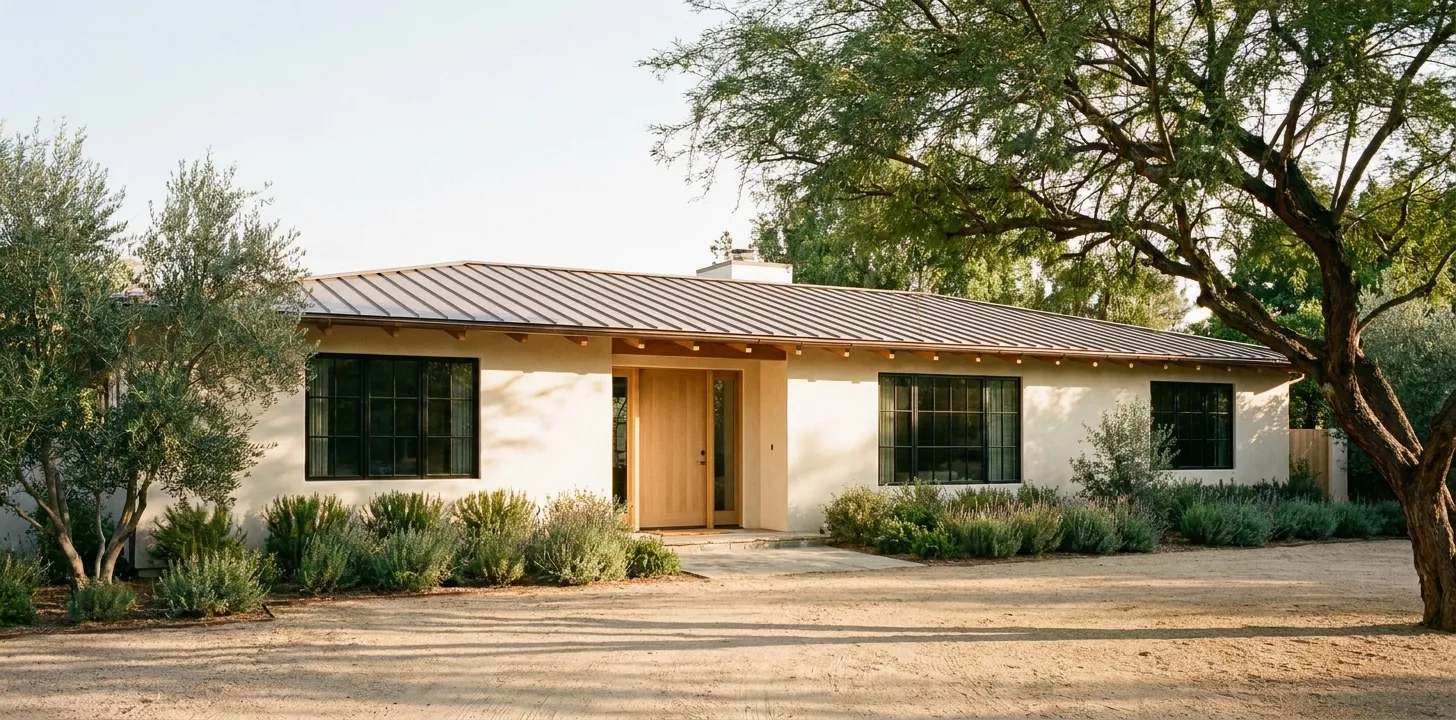
The single most-cited whole-house renovation cost benchmark on the internet is NerdWallet's "$15 to $150 per square foot" — a 10x range that's technically correct and operationally useless [1]. The actual cost of renovating a 1,800-sqft 1950s Arcadia ranch ranges from $72K (cosmetic refresh) to $918K (full gut to studs with luxury finishes and significant structural changes). The 13x spread is real. It is also entirely explained by which of the three project tiers you are doing. This piece breaks whole-house renovations into the three tiers that actually exist in the market, with real Phoenix 2026 costs for each, calibrated to City of Phoenix permit data and 12 completed Phoenix-area whole-house renovation projects.
The three whole-house renovation tiers — quick comparison
| Tier | Scope | Cost per sqft | Cost (1,800 sqft Arcadia ranch) | Timeline |
|---|---|---|---|---|
| Cosmetic refresh | Paint inside and out, refinish flooring, replace fixtures and hardware, update kitchen counters (no cabinet replacement), cosmetic bathroom updates (no tile replacement), new lighting. No walls move. No MEP work. | $40–$120/sqft | $72K–$216K | 8–14 weeks |
| Mid-gut (no walls move) | New kitchen (full cabinet + counter + appliance replacement), new bathroom tile and fixtures (existing layouts), new flooring throughout, new interior doors and trim, new windows, new HVAC system, new electrical (rewire to current code), paint inside and out. No structural changes. | $180–$280/sqft | $325K–$505K | 20–30 weeks |
| Full gut to studs | Strip to framing. New MEP throughout (electrical, plumbing, HVAC). New windows. Often layout changes (walls move, kitchen opens to great room). New roof. New exterior cladding option. New finishes throughout. New everything. | $330–$510/sqft | $595K–$920K | 36–52 weeks |
All-in cost including GC overhead (12%), pre-construction services, permits, and 12% contingency. Premium luxury finishes can push the full-gut tier to $600/sqft+ in Arcadia. Whole-house renovation cost varies meaningfully by home age — pre-1970 homes (every original Arcadia ranch) carry asbestos/lead testing premium and slab plumbing premium that newer homes don't.
Cosmetic refresh: $40–$120/sqft
A cosmetic whole-house refresh in Phoenix in 2026 runs $40–$120 per square foot all-in. On a 1,800-sqft Arcadia ranch, that's $72K–$216K total. The wide range reflects how much surface work is involved — at the low end, paint and basic fixture updates; at the high end, refinished flooring, new lighting throughout, new bathroom countertops and fixtures, refresh-grade kitchen updates (cabinet painting + new counters + new appliances without replacing cabinets).
What a cosmetic refresh does not include: layout changes, MEP work (no rewiring, no replumbing, no HVAC replacement), no new windows, no new roof, no cabinet replacement, no tile work beyond minor patching. If the existing finishes are intact and the systems work, the cosmetic refresh delivers the largest visual change for the lowest cost.
ARV recovery on a cosmetic refresh is 65%–95% — meaningfully better per-dollar than larger renovations because the finish-tier improvement creates an outsized buyer perception change with minimal cost. The cosmetic refresh is the right tool for pre-sale renovations 12–24 months before listing.
Mid-gut (no walls move): $180–$280/sqft
A mid-gut whole-house renovation — full kitchen and bathroom replacement, new flooring throughout, new HVAC system, new electrical (rewire to current code), new windows, but no structural changes — runs $180–$280 per square foot in Phoenix in 2026. On a 1,800-sqft Arcadia ranch, that's $325K–$505K all-in.
| Line item | Cost | % of total |
|---|---|---|
| Demolition and disposal | $18K | 4.5% |
| Kitchen (full gut, same layout) | $95K | 23.8% |
| Bathrooms (2 baths, same layout) | $58K | 14.5% |
| HVAC (full system replacement) | $24K | 6.0% |
| Electrical (full rewire to code) | $32K | 8.0% |
| Plumbing (selective replacement) | $18K | 4.5% |
| Windows (replace all) | $28K | 7.0% |
| Flooring throughout (engineered hardwood) | $22K | 5.5% |
| Interior paint, trim, doors | $24K | 6.0% |
| Exterior paint and stucco repair | $14K | 3.5% |
| Roof (if at end-of-life) | $22K | 5.5% |
| Labor (general, install) | $28K | 7.0% |
| GC overhead (12%) | $48K | 12.0% |
| Permits, design, contingency | $22K | 5.5% |
Representative composition from a 2025 mid-gut Arcadia renovation. Total all-in: $400K. Same layout throughout — no walls move.
ARV recovery on a mid-gut renovation is 70%–95%. The recovery is stronger when the renovation brings a dated home up to neighborhood comp ceiling without exceeding it. A mid-gut renovation that produces a quality level matching renovated comps in the neighborhood captures the full comp differential. A mid-gut that produces below-comp quality (cheap finishes, value-engineered selections) underperforms on ARV.
Full gut to studs: $330–$510/sqft
A full gut to studs — strip to framing, new MEP throughout, new windows, new finishes, often with significant layout changes — runs $330–$510 per square foot in Phoenix in 2026. On a 1,800-sqft Arcadia ranch, that's $595K–$920K all-in. At the high end with luxury finishes and architecturally-significant changes, the cost can exceed $1M.
| Line item | Cost | % of total |
|---|---|---|
| Demolition to studs | $45K | 7.1% |
| Structural (LVL beams for wall removal, foundation repair) | $55K | 8.7% |
| Kitchen (gut + layout change) | $165K | 26.0% |
| Bathrooms (2 baths, both with layout changes) | $98K | 15.4% |
| HVAC (full new system + ductwork redesign) | $32K | 5.0% |
| Electrical (full rewire + new panel + service upgrade) | $48K | 7.6% |
| Plumbing (full replacement including slab work) | $42K | 6.6% |
| Windows (replace all with premium tier) | $45K | 7.1% |
| Flooring throughout (premium hardwood or large-format tile) | $38K | 6.0% |
| Interior finish carpentry, trim, doors, paint | $45K | 7.1% |
| Exterior (new stucco, paint, possibly new roof) | $48K | 7.6% |
| Labor (general, install) | $32K | 5.0% |
| GC overhead (12%) | $76K | 12.0% |
| Permits, design, contingency | $66K | 10.4% |
Representative composition from a 2025 full-gut Arcadia renovation with layout changes. Total all-in: $635K. ARV at completion: $1.61M against $1.18M unrenovated comp.
ARV recovery on a full gut is 75%–110%. The strongest ARV cases are full guts of original mid-century Arcadia ranches: the unrenovated comp ceiling for a 1955 ranch is approximately $475–$520/sqft in Arcadia, the renovated comp ceiling is $680–$720/sqft. The differential of $160–$200/sqft on a 1,800-sqft footprint is $288K–$360K — often enough to cover the gut cost plus generate manufactured equity.
Cost to renovate a house by square footage
| Home size | Cosmetic (~$80/sqft) | Mid-gut (~$230/sqft) | Full gut (~$420/sqft) |
|---|---|---|---|
| 1,200 sqft (small ranch) | $96K | $276K | $504K |
| 1,500 sqft (typical 1950s ranch) | $120K | $345K | $630K |
| 1,800 sqft (Arcadia median) | $144K | $414K | $756K |
| 2,200 sqft (larger Arcadia ranch) | $176K | $506K | $924K |
| 2,800 sqft (custom build size) | $224K | $644K | $1.18M |
| 3,500 sqft (luxury build size) | $280K | $805K | $1.47M |
Midpoint cost per square foot for each tier. Actual project cost depends on specific finish selections, layout-change scope, and Phoenix-specific factors (asbestos/lead, slab plumbing, HVAC complexity). Add 10%–15% for pre-1978 home contingencies.
How $50K, $100K, $300K, and $500K renovations actually look
The most common renovation budget questions are at specific dollar thresholds. Real Phoenix examples at each:
- $50,000 renovation: A $50K budget covers either a cosmetic refresh of a 1,200-sqft small home (cabinet painting + new counters + new flooring + paint inside-out + new light fixtures) or a single-room project (one full bathroom remodel + master bedroom paint and flooring update). Not a kitchen renovation in Arcadia.
- $100,000 renovation: $100K covers a meaningful single-room project or a multi-room cosmetic refresh. Real examples: a primary bathroom remodel with layout change ($65K) + bedroom paint and flooring + new dining room lighting ($22K) + paint exterior ($13K). Or a kitchen cabinet replacement (no layout change) + new appliances + new counters ($85K) + minor bath refresh ($15K).
- $300,000 renovation: $300K is the threshold where mid-gut scope becomes feasible. Real examples: a 500-sqft master suite addition ($245K) + powder room refresh ($25K) + kitchen counter and appliance update ($30K). Or a full kitchen and primary bathroom gut without layout changes ($210K) + new flooring throughout ($55K) + new HVAC system ($35K).
- $500,000 renovation: $500K is the threshold where a real mid-gut whole-house renovation is achievable. Real examples: kitchen full gut ($165K) + 2 bathrooms full remodel ($95K) + new flooring throughout ($65K) + new HVAC system ($35K) + new windows ($45K) + electrical rewire to code ($40K) + paint inside and out ($55K). Or a full gut of a smaller home (1,200 sqft × $420/sqft = $505K).
Whole house renovation ROI by tier
| Tier | Cost (1,800 sqft Arcadia) | ARV uplift | Recovery % | Manufactured equity |
|---|---|---|---|---|
| Cosmetic refresh | $140K | $120K–$170K | 85%–120% | ($20K)–$30K |
| Mid-gut, no layout change | $400K | $285K–$410K | 70%–100% | ($115K)–$10K |
| Full gut, layout change, right-sized finish | $635K | $580K–$735K | 90%–115% | ($55K)–$100K |
| Full gut, layout change, over-spec'd finish | $850K | $700K–$820K | 80%–95% | ($150K)–($30K) |
Manufactured equity = ARV uplift minus project cost. Negative means the renovation didn't fully recapture in immediate ARV; positive means manufactured equity. Range reflects neighborhood comp variability and finish-tier alignment.
The pattern in the data: cosmetic refreshes often recover full cost plus a small positive ($0–$30K). Full guts at right-sized finish often recover full cost plus meaningful positive ($55K–$100K). Mid-gut renovations and over-specd full guts typically don't recapture full cost — they're quality-of-life decisions with partial ARV recovery, similar to bathroom remodels. The financial case for a whole-house renovation is strongest at the two extremes (light cosmetic or full gut with comp-aligned finish) and weakest in the middle.
Phoenix-specific whole-house renovation factors
- Asbestos and lead paint testing. Every original Arcadia ranch was built pre-1978 and likely contains asbestos floor tile, asbestos pipe insulation, and/or lead paint. Testing: $400–$800. Actual abatement, if found: $4K–$22K depending on scope. Budget $5K of contingency for testing + minor remediation on any whole-house renovation in a pre-1978 home.
- Slab plumbing replacement. Cast-iron drain lines from 1950s-era Arcadia have 50–75 year service lives. Many are now at end-of-life. A whole-house renovation often triggers replacement of all under-slab cast-iron drain lines: $18K–$45K depending on layout. About 30% of full guts in original Arcadia ranches encounter this.
- Electrical service upgrade. Original Arcadia electrical service was typically 100A — far below modern 200A code requirements for full-house renovations with electric appliances, HVAC, and modern lighting. Upgrade cost: $4,500–$9,500. For homes adding electric vehicle charging, induction cooking, or large HVAC loads, a 400A service is increasingly common: $9,500–$18,000.
- HVAC sizing and zoning. Phoenix HVAC sizing on a whole-house renovation is more aggressive than national norms (1 ton per 500–700 conditioned sqft vs. 1 ton per 800–1,000 in milder climates). Mid-gut and full-gut renovations almost always require an updated HVAC sizing analysis and frequently require zoning the home into 2–3 separate HVAC zones for proper comfort.
- Roof replacement. Original Arcadia ranches with tar-and-gravel or asphalt-shingle roofs from the 1950s have all reached end-of-life. Whole-house renovation is the natural moment to replace: $18K–$32K for a typical 1,800-sqft footprint.
- Permit timeline. Phoenix Plan Review for a whole-house renovation runs 16–24 weeks from application to issued permit. Plan-review re-submittals are common (50%–70% of whole-house permits require at least one re-submittal): 6–10 weeks added. Budget for the permit clock as part of the total project timeline.
- Historic-overlay restrictions. Specific Arcadia subdivisions have historic-overlay status with restrictions on exterior changes, window styles, roof materials, and additions. Verify zoning before committing to design fees. Typical historic-overlay constraint cost: $15K–$45K added for compliant material selections.
How to finance a whole-house renovation in Arizona
Whole-house renovations land in the $72K to $1.5M+ range across the three tiers. The financing path depends primarily on project size and existing mortgage rate:
- Cosmetic refresh under $150K: HELOC or cash. Below this threshold, the cost of structuring a renovation loan exceeds the rate savings.
- Mid-gut $150K–$500K: ARV construction loan in second position. The loan size justifies the structuring cost, the post-renovation appraisal captures the manufactured equity, and the existing first mortgage stays intact at its low rate.
- Full gut $500K+: ARV construction loan from a portfolio lender (Bell Bank, Western Alliance, or an Arizona private bank). Two-Time Close structure preferred for full guts because it allows scope and rate flexibility at the permanent close. For projects above $1.5M, private banking relationships at portfolio lenders typically provide the cleanest path.
For the full Arizona renovation loan comparison, see Renovation Loans in Arizona. For the renovation-HELOC-vs-renovation-loan decision specifically, see Renovation HELOC vs Renovation Loan in Arizona.
How to scope a whole-house renovation before talking to a contractor
- Decide on tier: cosmetic refresh, mid-gut, or full gut. Tier is the biggest cost variable; walls-moving or not is the biggest within-tier variable.
- Multiply your home's square footage by the midpoint $/sqft for your tier: cosmetic ~$80/sqft, mid-gut ~$230/sqft, full gut ~$420/sqft.
- Add 15% for pre-1978 home contingencies (asbestos/lead, slab plumbing, electrical service upgrade).
- Add 12% project contingency for Phoenix-specific risks: HVAC sizing, roof replacement, slab discoveries, permit re-submittals.
- For full guts, walk the property with a structural engineer before committing to design fees — the load-bearing wall map determines what layout changes are possible without significant structural work.
- For full guts, validate ARV uplift against neighborhood renovated comps before committing — over-specifying finishes on a sub-comp lot destroys manufactured equity quickly.