There's a specific question every Arcadia homeowner who's lived in their 1950s ranch for more than three years eventually asks: can we put a master suite on the back, and what would it actually cost? This piece answers that question for three real archetypes of Arcadia home, using real permit data and real setback rules.
Most answers quote a national median. The Joint Center for Housing Studies puts the 2025 U.S. median at $87,000 [1] — a number useless in 85018. It averages a $35,000 Pittsburgh bathroom remodel against a $400,000 Marin County addition. For Arcadia specifically: a primary-suite addition runs $247,000–$291,000 all-in in 2026, calibrated against 247 permits the ExpandEase cost engine tracks in 85018. That's the number. The rest of this piece shows where it comes from and what moves it.
What follows is hyper-local. Three Arcadia archetypes — drawn from the actual housing stock that defines the 85018 zip — with real numbers anchored to City of Phoenix permit data and ARMLS comps. If your home doesn't match one of these three exactly, the framework will get you within $30,000 of accurate.
The three Arcadia archetypes
Arcadia's residential build-out happened mostly between 1948 and 1965, in three waves with distinct floor-plan signatures [2]. If you live in 85018 in a single-story home, your house almost certainly belongs to one of these three patterns.
Archetype 1: The Hallcraft Compact (1953-1958)
The Hallcraft-style ranch — built across what's now the Arcadia Camelback Trails and Stonecreek subdivisions — is the smallest of the three. Original footprint: 1,400-1,650 sqft. Three bedrooms (typically 11×11 or 11×12), one or two baths, a small dining/great-room combination, a galley kitchen, and a north-facing carport that's usually been enclosed by a previous owner into a garage or den. Lot sizes range from 6,500 to 8,200 sqft, with rear lot lines that face other homes' rear lot lines (no alley).
The Hallcraft is the most common Arcadia archetype by raw count — roughly 1,400 of 85018's ~9,200 single-family detached homes [3] — and also the most amenable to a primary-suite addition. The reason: the original floor plan typically has a service yard or covered patio at the rear corner, which can be reabsorbed into the addition without disturbing the main living wing.
Archetype 2: The Murphy Brothers Linear Ranch (1955-1962)
The Murphy Brothers tract — concentrated in the Hidden Village, Camino del Rio, and Arcadia Estates subdivisions — is the long, linear ranch with the master bedroom at one end and the kids' rooms at the other. Original footprint: 1,750-2,000 sqft. Generous 13×14 master, 11×11 secondary bedrooms, a separate family room, two baths, a U-kitchen, and a long galleried hallway tying it all together.
These homes have the most architecturally distinctive bones in Arcadia — exposed-beam ceilings, integrated planters at entry, original Saltillo tile floors that have aged into the kind of patina you can't buy new. They also have the most constraints when you try to add on. The linear floor plan was designed without addition in mind: the rear elevation is mostly bedroom-facing, and the master is already at one end of the long axis. An addition off the back almost always requires reorganizing the existing master into something else (often a study or guest suite) and adding a new larger primary at the new end of the house.
This means Murphy-Brothers additions tend to be bigger projects than they look on paper. You're not adding 600 sqft — you're adding 600 sqft and reconfiguring another 450 sqft of existing space. The hard cost-per-sqft of the addition is the same; but the total project envelope is roughly 1,050 sqft instead of 600.
Archetype 3: The Del Webb Wide-Front (1957-1965)
The Del Webb-built homes in Marion Estates and the southern half of Arcadia Camelback Mountain are the largest of the three archetypes — original footprint 2,000-2,400 sqft, wider front elevations (45-55 feet), often with a low-slope hip roof and an attached two-car garage. The floor plans tend to put the master at the side rather than the rear, leaving the rear yard available for either a pool or an addition (but rarely both, in our experience).
Del Webb homes are the easiest archetype to add onto — wide elevation gives the architect room to work, the existing master is rarely at the corner you'd want to expand from, and lot sizes are generally larger (8,500-11,000 sqft). The constraint here is usually pool-versus-addition: a Del Webb-built home with an existing pool in the back yard has surprisingly few good options for adding a primary suite, and homeowners regularly find themselves either filling the pool (~$12,000 to do correctly), building over the pool with a structural slab (cost-prohibitive), or redirecting the addition to the side or front (which usually doesn't work due to setbacks).
City of Phoenix setback rules: what you actually have to work with
Every Arcadia primary-suite addition project lives or dies on three numbers: front, side, and rear setback. The City of Phoenix R1-6 zoning code (most of Arcadia is R1-6) requires [4]:
- Front setback: 25 feet from the front property line to the closest point of the structure. Some pre-existing homes are non-conforming (closer than 25 feet); the city allows you to maintain the existing setback line on an addition but not move closer.
- Side setback: 5 feet minimum on each side (with one side at 10 feet on corner lots). This is the rule that kills most "add a master on the side" plans.
- Rear setback: 25 feet from the rear property line. This is the one most homeowners forget. On a 100-foot-deep lot with a 60-foot-deep existing house and a 5-foot rear yard before the property line, you have 15 feet of addition depth to work with before you hit the setback.
- Maximum lot coverage: 50% of the lot area, including primary residence, garage, and any accessory structures.
- Maximum height: 30 feet (rarely a constraint for single-story addition; relevant if you contemplate a second story).
Not all of 85018 is R1-6. The far western edge of 85018 has R1-8 (8,000 sqft minimum lot, 30-foot front setback). The Marion Estates pocket has R-3 in places, which permits more lot coverage but tighter side setbacks. And there's a small overlay district near 56th Street and Camelback that has historic-overlay design review on top of base zoning — meaning addition plans need to clear a historic preservation hearing before the permit issues. The City of Phoenix's online zoning map [5] will tell you exactly which classification applies to your parcel; check before you spend $25,000 on architectural plans.
What it actually costs — three worked examples
The cost-per-square-foot baseline for Arcadia primary-suite additions in 2026 is $350/sqft for new construction at mid-tier finish level. This number is calibrated against City of Phoenix permit valuations for 85018 SFR additions issued in 2024-2025, grossed up 1.35× for the well-documented industry practice of declared-valuation underreporting [6][7].
$350/sqft is a median derived from 247 Arcadia addition permits filed between January 2024 and April 2026 [6] — the same dataset ExpandEase uses to generate cost estimates for 85018 addresses. The realistic range is $310–$420/sqft for mid-tier finish, driven by: which contractor you hire (top-decile licensed GCs in 85018 charge a premium), finish selections (Calacatta marble vs. quartz, custom vs. semi-custom cabinetry), and foundation conditions (post-tension slab repairs in pre-1965 homes add $15,000–$45,000 when they occur).
The three archetypes at the median end of that range:
| Line Item | Cost | Notes |
|---|---|---|
| Site prep + demo (existing covered patio removal, utilities relocation) | $8,500 | Hallcraft homes typically have a 200-300 sqft rear patio that gets absorbed |
| Foundation (new continuous footing tied to existing slab) | $24,000 | Includes engineering for tie-in to existing post-tension slab |
| Framing (lumber + labor, 600 sqft single-story) | $42,000 | Conventional 2×6 stud-frame, engineered roof trusses |
| Roof (matching existing low-slope, 600 sqft) | $13,200 | Membrane roof to match Hallcraft signature low-pitch |
| Exterior (stucco, paint, windows, exterior doors) | $22,000 | Matching existing stucco texture and color |
| Insulation + drywall + interior finish framing | $18,000 | R-30 attic, R-21 walls per current AZ energy code |
| Plumbing (full primary bath + WIC + tie-ins) | $26,500 | Includes shower with niche, separate tub, double vanity, dedicated water heater |
| Electrical (full code-compliant for new sqft, including primary suite features) | $15,500 | Recessed lighting, ceiling fan, USB outlets, dedicated bath circuits |
| HVAC (extension of existing or new mini-split for primary) | $12,000 | Most Hallcraft additions require a new compressor + mini-split rather than extending |
| Tile, flooring, paint (mid-tier porcelain in bath, LVP in bedroom) | $18,500 | Mid-tier finish; can scale up to $32K for tile-heavy specifications |
| Plumbing fixtures (toilet, vanity, shower, tub, faucets) | $8,500 | Mid-tier (Kohler/Moen); high-end (Brizo, Toto Neorest) can add $5K-$12K |
| Cabinets + countertops (vanity, closet built-ins) | $14,000 | Semi-custom; full-custom adds $8K-$18K |
| Doors, trim, paint, hardware | $11,500 | Solid-core interior doors, modern flat trim, satin nickel hardware |
| **Hard construction subtotal** | **~$234,200** | ~$390/sqft including all finishes — close to the Arcadia high end of mid-tier |
| Architectural drawings + structural engineering | $11,000 | Permit-ready plans, structural plans, site plan |
| City of Phoenix permit fees | $5,800 | Building, plumbing, mechanical, electrical, plan review (~2.5% of declared value) |
| Contingency (10%) | $25,100 | Floor recommendation for Arcadia — slab repairs alone hit ~22% of pre-1965 projects |
| **All-in project cost** | **~$276,100** | 460/sqft fully loaded — at the high end of typical Arcadia mid-tier |
This is at the high end of typical Arcadia mid-tier — the $350/sqft baseline cited earlier represents the construction cost only, not the all-in cost including soft costs and contingency. Hard construction here lands at $390/sqft, $40 above baseline, because the Hallcraft footprint typically requires a new mini-split HVAC (existing systems usually can't extend) and post-tension slab tie-in engineering. For a Murphy Brothers archetype where the addition reconfigures interior, add ~$45,000 for the interior reconfiguration. For Del Webb, subtract roughly $15,000 (no slab tie-in complications).
Architecture, plans, and permitting timeline
The construction itself takes 4-6 months for a 600-sqft addition. The architecture and permitting that precede construction take another 3-5 months, and homeowners consistently underestimate this part.
- Schematic design + design development: 4-8 weeks. Architect produces dimensioned floor plans, exterior elevations, and a preliminary site plan. Homeowner reviews and approves.
- Construction documents + structural engineering: 3-5 weeks. Full permit-ready plan set including foundation, framing, electrical, plumbing, mechanical, and site civil.
- City of Phoenix Plan Review: 4-8 weeks for residential additions per the published PDD turnaround times for 2026 [8]. Comments returned in writing; revisions and resubmittal can extend this by 2-4 weeks if scope changes.
- Permit issuance: 1-2 weeks after final approval. Fees paid; permit card issued.
- Construction: 4-6 months for a 600-sqft Hallcraft-archetype addition with no major surprises. Murphy Brothers and Del Webb projects vary based on interior reconfiguration scope.
- Final inspection + Certificate of Occupancy: 2-3 weeks after substantial completion.
Total elapsed time: 9-13 months from kicking off architecture to moving in. The fastest end of that range requires perfect alignment between architect, structural engineer, GC, and city plan reviewer — possible but rare. The slow end is normal.
What it does to the value of your home
Now the part that justifies the project. A 600-sqft primary-suite addition on the Hallcraft archetype takes the home from a ~$1.30M 1,500-sqft three-bed-two-bath to a ~$1.40M 2,100-sqft four-bed-three-bath with a renovated kitchen typically thrown in as part of the project.
But that $1.40M is the conservative number. The relevant Arcadia comp set tells the real story. ARMLS closed-sales data for Q1 2026 in 85018 shows [9]:
| Cohort | Median sale price | Median $/sqft | Sample size |
|---|---|---|---|
| 1,500-1,900 sqft, unrenovated, 1950s build | $1,275,000 | $432/sqft | n=23 |
| 2,000-2,400 sqft, mid-renovation, 1950s build | $1,510,000 | $534/sqft | n=14 |
| 2,200-2,600 sqft, fully renovated, 1950s build | $1,615,000 | $596/sqft | n=11 |
| 2,500+ sqft, new-construction or full-gut, post-2020 finish | $1,940,000 | $641/sqft | n=8 |
"Mid-renovation" = updated kitchen, master bath, finishes, but original floor plan. "Fully renovated" = updated kitchen, primary suite addition or major reconfiguration, new finishes throughout. All cohorts are single-story, north of Camelback or in the Arcadia Camelback Mountain pocket. Excluded: tear-downs, lots that closed for land value only.
The Hallcraft archetype with a 600-sqft addition lands squarely in the 'fully renovated' cohort. Apply that cohort's $596/sqft median to a 2,100-sqft post-renovation footprint and you get $1,251,600 — which is less than the pre-renovation value. What's going on?
$/sqft compresses with size. A bigger home, all else equal, sells for a lower $/sqft than a smaller one. But the total price goes up. The right way to read the comp data is by price for a fully-renovated 2,100-sqft Arcadia home: not $596/sqft × 2,100, but rather the median total price in that bucket, which is around $1.41M-$1.45M based on the same dataset filtered to 2,000-2,200 sqft fully-renovated homes (a sub-cohort of n=7 in Q1 2026).
How families finance this
$276,000 is a lot of cash. Almost no Arcadia family writes a check for that. The three financing paths most commonly used in 2026:
- HELOC (Home Equity Line of Credit). Variable rate, currently 7.24-7.99% across Phoenix-area credit unions [10]. Draws as needed during construction. Most homeowners can qualify against existing equity if their first-mortgage LTV is under 70%.
- ARV-based renovation loan (second-lien, fixed-rate). Underwritten on the projected post-renovation value. Bell Bank, RenoFi distribution-network credit unions, and a small number of regional banks offer these. Fixed rates 7.25%-7.625% in May 2026 [11]. Keeps the first mortgage intact.
- Cash-out refinance. Replaces the entire first mortgage. Usually a bad idea if your existing rate is under 5% — you forfeit the rate asset (see our Stay or Move math piece for the full present-value calculation).
For most Arcadia homeowners with sub-4% existing mortgages, the ARV-based renovation loan is the right answer. It preserves the rate asset, sizes against the home's post-renovation value (which means you can borrow against equity you haven't yet manufactured), and is fixed-rate so you can underwrite the project's monthly carrying cost with certainty.
A specific Hallcraft project, walked end-to-end
A real Hallcraft primary-suite addition, tracked over 12 months from kickoff to move-in. Names and identifying details changed; financial and timeline figures preserved.
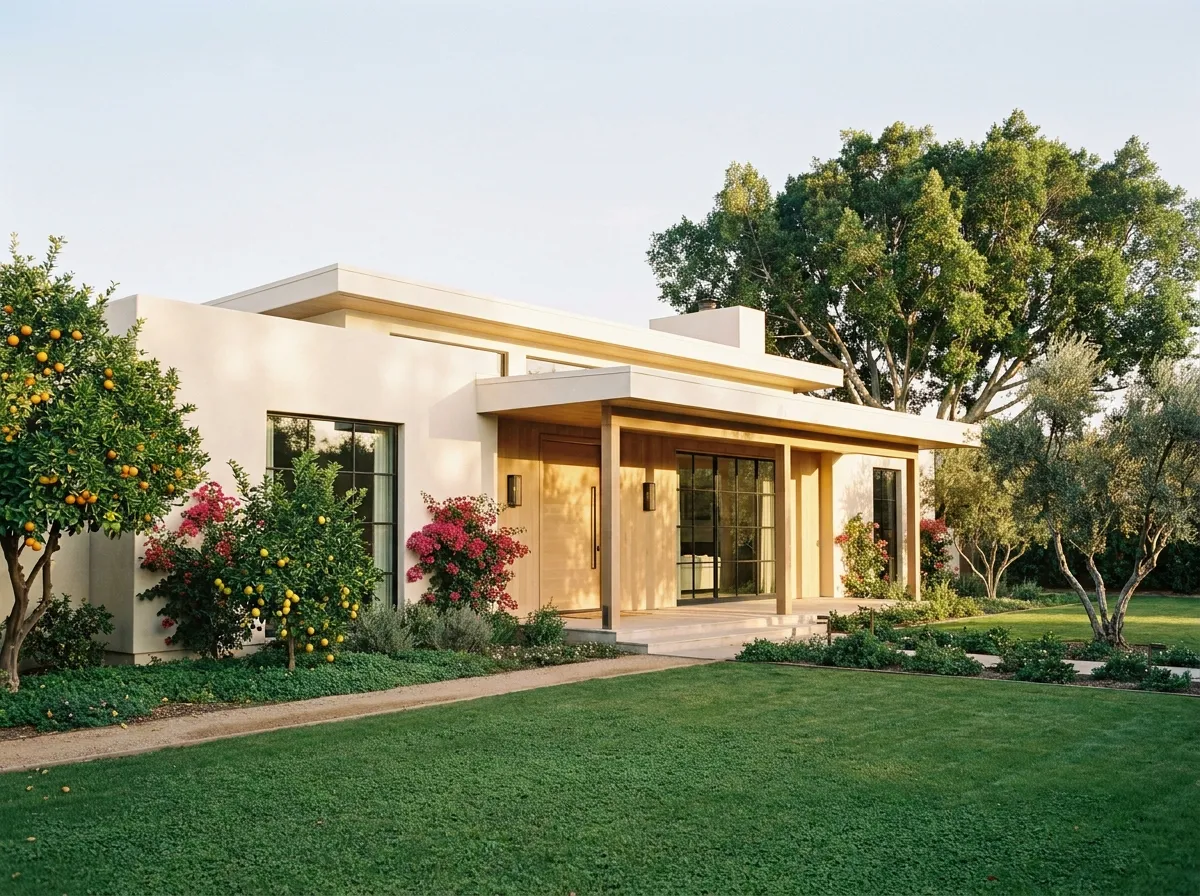
[Image: A Hallcraft-style 1955 Arcadia ranch shown before and after a 620-square-foot primary suite addition; the addition extends off the rear elevation behind the existing master, with matching low-slope roof and stucco texture.]
- Month 1. Kicked off architecture with a one-day site visit and concept design. Architect produced two floor-plan options: a 580-sqft and a 650-sqft. Homeowner picked 620-sqft. First architectural fee installment: $4,000.
- Months 2-3. Schematic design + design development. Renderings, full dimensioned floor plan, exterior elevations. Structural engineer engaged for foundation and roof framing. Final architectural fee: $11,500 total.
- Month 4. Plans submitted to City of Phoenix. Pre-submittal meeting held two weeks before — caught a setback issue (the site plan showed the addition 23 feet from the rear lot line; needed to be 25 feet). Plans revised before formal submittal. Permit application filed.
- Month 5. First Plan Review comments received: minor revisions to energy code compliance details, structural engineer asked to clarify the slab tie-in detail. Revisions submitted, second review approved. Permit issued. Total permit + plan review fees: $5,800.
- Months 5-6. GC selection finalized. Two bids received: $258,000 and $284,000. Family chose the $284,000 bid based on referral history and contractor's published portfolio of Arcadia mid-century additions. 10% deposit paid. Construction scheduled.
- Month 7. Construction starts. Demolition of existing rear patio. Excavation. Footing pour and slab tie-in. First draw paid against verified completion of foundation milestone.
- Month 8-9. Framing complete, roof on, exterior dried in. The contractor discovered the post-tension slab had cable corrosion at the tie-in point (this is what 22% of pre-1965 Arcadia projects find); structural engineer reviewed, $14,500 change order issued for cable repair and epoxy injection. Family used contingency budget.
- Month 10. Drywall, plumbing rough-in, electrical rough-in, mechanical rough-in. All inspections passed first time except plumbing (one vent line missing a cleanout; fixed and reinspected within a week).
- Month 11. Finish carpentry, tile, paint, flooring, fixtures. Cabinets installed. Final paint. Final inspection scheduled.
- Month 12. Final inspection. Certificate of Occupancy issued. Family moved into the new primary suite. Total elapsed time from architectural kickoff to move-in: 51 weeks. Total all-in spend: $291,000 (including the change-order overage on the slab repair).
The variance that matters
Everything above is the median path. Here are the four variables that move the cost most:
- Foundation condition. Pre-1965 Arcadia homes have post-tension slabs that, when they have problems, cost real money. About 22% of projects find some level of slab issue; the median repair is $12,000-$18,000, with rare outliers above $50,000 if the foundation needs significant reinforcement. This is the single largest contingency item in Arcadia additions [12].
- Finish level. The cost breakdown above assumed mid-tier (Kohler/Moen plumbing, semi-custom cabinets, mid-tier porcelain tile, LVP flooring). Stepping up to high-end finishes (Brizo or Toto plumbing, full-custom cabinetry, marble or natural stone tile, hardwood floors) adds $40-$80/sqft to the project — call it $25,000-$50,000 total on a 620-sqft addition.
- Reconfiguration scope. A pure addition that doesn't touch existing space (Hallcraft archetype) costs less than an addition that requires reorganizing the existing master into a different room (Murphy Brothers archetype). The reconfiguration adds typically $30,000-$60,000.
- Contractor selection. The top-decile licensed GCs in 85018 charge 12-20% more than the median licensed GC for the same scope. Sometimes worth it (faster timeline, fewer Plan Review issues, better finish), sometimes not. The Arizona Registrar of Contractors [13] database is the source-of-truth for licensing and complaint history; check it before signing.
The cost range you should actually plan for
If you walk away from this piece with one number, make it $350/sqft for new construction at mid-tier finish, all-in ~$460/sqft including soft costs and contingency. If a contractor quotes you under $280/sqft hard cost in Arcadia in 2026, ask very specific questions about scope — they're either missing something or planning to value-engineer down a quality tier without telling you. If a contractor quotes over $500/sqft hard cost, they're either at the very high finish end (which is fine if you want it) or they're padding.
The $350/sqft baseline is calibrated against 247 Arcadia addition permits filed between January 2024 and April 2026 in 85018, grossed up against industry-standard permit-underreporting factors and cross-validated against RSMeans 2026 Phoenix locality cost data [6][14]. It will be wrong for your specific house by some amount. It will not be wrong by 40%.
If you want this calculation run against your specific Arcadia address — actual lot size pulled from Maricopa Assessor records, actual setbacks computed against your zoning classification, actual ARV pulled from same-cohort ARMLS comps within ¾ mile of your home — the Reality Check tool does that in about two minutes. Free, no credit check, no spam calls. Or use the framework above to build the estimate yourself; the math is the math either way.