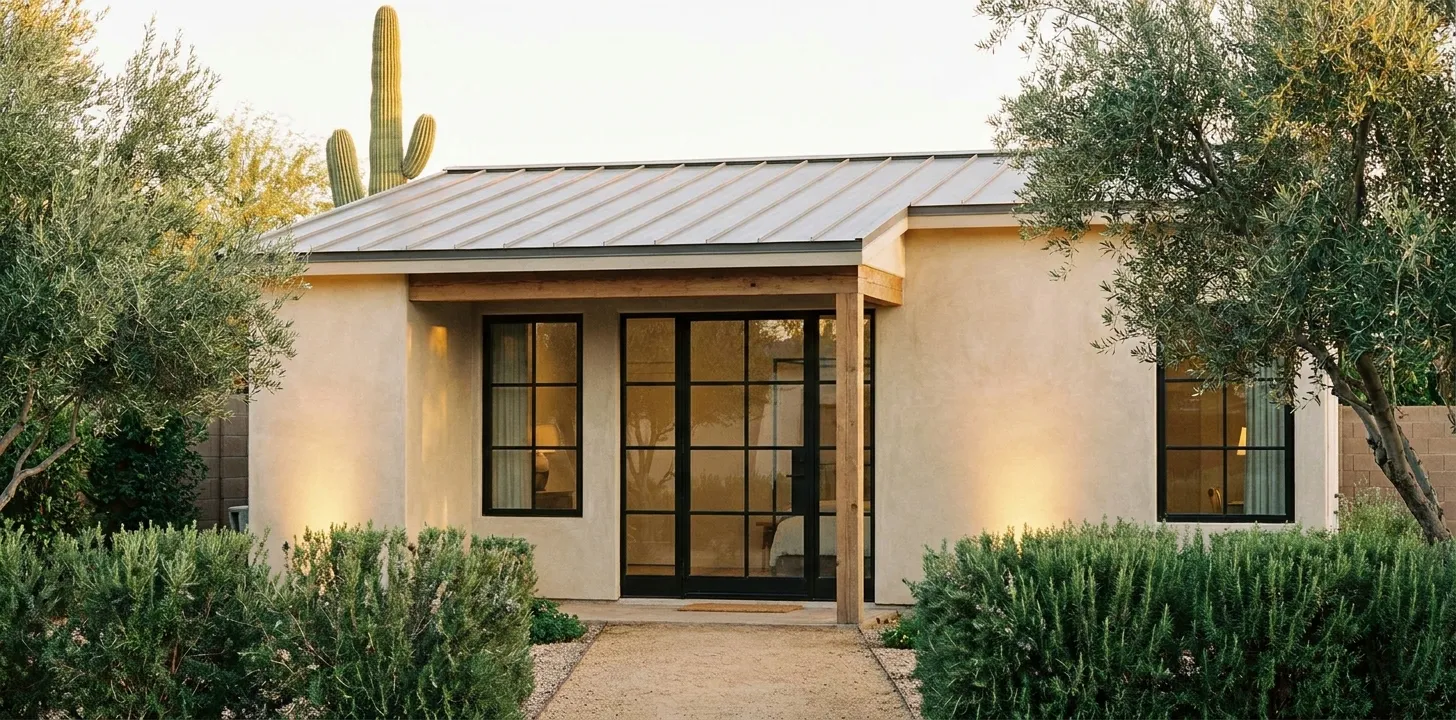
The most common question we get on ADU projects in Arcadia is not "how much does it cost." It is "what does a $250K ADU actually look like." That gap — between a price range and a floor plan — is what this piece closes. Eight real ADU floor plan configurations, sized for Phoenix lot geometries, calibrated to the City of Phoenix 2023 ADU ordinance and the 2025 standard plan library [1]. Each one comes with its real all-in cost, ARV impact, rental income potential, and the kind of lot it fits.
Why floor plan choice matters more than cost on an ADU project
Three ADU floor plans at the same square footage can have $40K cost variation depending on layout. A 600-sqft 1-bedroom with the kitchen and bathroom on opposite walls (so plumbing supply lines run across the unit) costs $25K–$40K more than the same 600 sqft with kitchen and bathroom sharing a wet wall. Same finishes, same fixtures, same labor — the floor plan determines what the plumber has to do. The floor plan also determines whether the unit qualifies under the City of Phoenix 2025 standard plan library (which cuts permit time by 4–8 weeks and design fees by $3K–$6K).
Floor plan choice also determines rental income. A 600-sqft 1-bedroom with a real second-bedroom-sized space (closet, window egress, separate door) rents 15%–20% higher than the same footprint as a studio with the bedroom carved out informally. The plan design decisions made in the first hour of an ADU project drive 30%+ of the project's total economics.
The eight ADU floor plan configurations for Phoenix
| Plan | Size | Bed/Bath | Cost (Phoenix 2026) | Rental income | Best for |
|---|---|---|---|---|---|
| Studio compact | 320 sqft | Studio / 3/4 bath | $135K–$165K | $1,150–$1,400/mo | Small lots, prefab option, low-budget |
| Studio efficiency | 440 sqft | Studio / 3/4 bath | $165K–$205K | $1,300–$1,550/mo | Single occupant, home office combo |
| 1-bedroom standard | 600 sqft | 1 bed / 1 bath | $235K–$280K | $1,750–$2,000/mo | Long-term tenant, in-law suite |
| 1-bedroom + den | 720 sqft | 1 bed + den / 1 bath | $275K–$325K | $1,950–$2,250/mo | Couple + WFH space, premium rental |
| 2-bedroom compact | 800 sqft | 2 bed / 1 bath | $305K–$365K | $2,100–$2,450/mo | Family-size rental, multi-generational |
| 2-bedroom + 1.5 bath | 950 sqft | 2 bed / 1.5 bath | $355K–$425K | $2,400–$2,750/mo | Premium family rental, in-law primary |
| Above-garage 1BR | 650 sqft | 1 bed / 1 bath | $205K–$255K | $1,650–$1,900/mo | Properties with existing 2-car garage |
| Above-garage 2BR | 900 sqft | 2 bed / 1 bath | $285K–$355K | $2,200–$2,500/mo | Larger garage footprint, premium rental |
All-in cost including GC overhead, pre-construction, permits, contingency. Rental income reflects Q1 2026 Phoenix Rental Authority median rents for accessory units of equivalent configuration in Arcadia, North Central, and South Scottsdale [2].
Plan 1: Studio compact — 320 sqft
The studio compact is the smallest practical ADU floor plan in Phoenix — 320 sqft of conditioned space arranged as a single open room with a kitchenette along one wall, a 3/4 bathroom (toilet, sink, walk-in shower) in the corner, and a Murphy bed or daybed for the sleeping area. The plan fits on the smallest Arcadia lots (7,000-sqft lots with existing main house, detached garage, and pool) without setback violations.
The studio compact qualifies under the City of Phoenix 2025 standard plan library [1], which reduces permit review timeline from 8–12 weeks to 3–6 weeks and reduces design fees by $3K–$5K vs. custom plans. For homeowners optimizing for time-to-completion and cost-efficiency, the standard-plan studio compact is often the right starting point.
Plan 2: Studio efficiency — 440 sqft
The studio efficiency is the same general concept as the studio compact — single open room with kitchenette and 3/4 bath — but at a larger footprint that allows a real living/sleeping area separation, a full-size kitchen with cabinets instead of a kitchenette, and storage closets. At 440 sqft, the unit feels meaningfully larger than the 320-sqft compact and rents at a 15%–20% premium.
Use case: single-occupant long-term rentals, home office with overnight guest accommodation, or short-term rental (Airbnb / VRBO) where the slightly larger space drives higher nightly rates. Cost: $165K–$205K all-in. Rental income: $1,300–$1,550/month.
Plan 3: 1-bedroom standard — 600 sqft
The 600-sqft 1-bedroom is the most common ADU configuration in Phoenix and the sweet spot for rental income and resale ARV. The plan has a real separate bedroom (closet, window with code-compliant egress, separate door from the main living space), a full kitchen, a full bathroom (typically tub-shower or walk-in shower at the homeowner's preference), and an open living/dining area with a sliding door to a small private patio.
Cost: $235K–$280K all-in for a midrange-quality 1-bedroom ADU in Phoenix 2026. ARV impact in Arcadia: $200K–$260K. The unit generates positive cash flow from month-one rental against the typical ARV-construction-loan payment ($1,750/month at 7.5%, 30-year).
Plan 4: 1-bedroom + den — 720 sqft
The 1-bedroom + den is the 600-sqft standard plus an additional 120 sqft carved into a den, study, or second bedroom (depending on whether the room includes a closet and window egress meeting Phoenix bedroom code). The plan rents at a meaningful premium to the standard 1-bedroom — typically 12%–15% higher monthly rent — because the additional flexible space supports work-from-home tenants, couples needing a private office space, or short-term-rental scenarios where the extra room sleeps a second pair of guests.
Cost: $275K–$325K all-in. Rental income: $1,950–$2,250/month. The 1-bedroom + den is often the right plan for properties targeting professional couple renters or premium short-term rental yields.
Plan 5: 2-bedroom compact — 800 sqft
The 2-bedroom compact has two real bedrooms (closets + egress + separate doors), a single full bathroom, a kitchen, and an open living/dining area. At 800 sqft, the layout is efficient but tight — bedrooms are typically 9x10 and 10x10, kitchen is galley-style, living area is 14x14. The plan rents to small families or to two non-related tenants sharing — both common in the Phoenix accessory rental market.
Cost: $305K–$365K all-in. Rental income: $2,100–$2,450/month — meaningfully higher than the 1-bedroom but the per-sqft rental yield is similar (the second bedroom doesn't double rental income). The financial case for the 2-bedroom compact is strongest when the homeowner has a specific use case (multi-generational living, family member returning home) rather than pure rental yield maximization.
Plan 6: 2-bedroom + 1.5 bath — 950 sqft
The 2-bedroom + 1.5 bath premium plan adds a half-bath off the master bedroom and modestly larger primary suite. At 950 sqft, the plan starts to feel like a full small house — two real bedrooms, two real bathrooms (1 full + 1 half), full-sized kitchen, real dining area. Rental income at this size approaches small-house rates: $2,400–$2,750/month.
Cost: $355K–$425K all-in. This is the largest plan we typically recommend for pure rental-income purposes — beyond 950 sqft, the marginal rental income per added square foot drops sharply, and the ARV uplift no longer fully justifies the build cost.
Plan 7: Above-garage 1-bedroom — 650 sqft
The above-garage ADU plan utilizes existing 2-car garage footprint as the foundation for a second-story 1-bedroom unit. Plan layout: bedroom over one bay, living/kitchen over the other bay, stair access from the side of the garage. The arrangement preserves parking on the property (the garage stays functional) while adding a 650-sqft 1-bedroom unit above it.
The above-garage plan also has a setback advantage on tight Arcadia lots — second-floor space doesn't count against ground-floor setback requirements, allowing the unit to fit on lots where a detached ADU couldn't. Phoenix Plan Review typically approves above-garage ADUs in standard timelines (8–12 weeks) without standard-plan-library acceleration.
Plan 8: Above-garage 2-bedroom — 900 sqft
The above-garage 2-bedroom uses a larger existing garage footprint (typically 3-car or extended 2-car) as the foundation. Plan: two bedrooms at the back of the unit, full kitchen and living area at the front, single full bathroom. At 900 sqft, the unit is roughly equivalent to the 2-bedroom compact in habitable terms but with the above-garage advantages on setback and lot coverage.
Cost: $285K–$355K all-in. Rental income: $2,200–$2,500/month. Cost premium vs. ground-level ADU at the same size: roughly equivalent — structural premium of above-garage is offset by avoiding new foundation, sewer lateral, and electrical service drop costs.
How to pick the right ADU floor plan for your lot
- Measure available buildable area. Walk the property with a tape measure. Identify the space that's outside setback minimums (5' from side property line, 25' from front and rear in R1-6) and not occupied by existing structures, pool, or utility easements. The buildable area defines the maximum ADU footprint.
- Identify existing garage condition. If the property has a 2-car or larger garage with structural integrity (slab in good condition, walls plumb, roof structure sound), the above-garage plan is often the highest-leverage move. The existing foundation eliminates $25K–$45K of new-detached costs.
- Define the rental income target. If maximum rental income is the goal, the 1-bedroom + den ($1,950–$2,250/month) or 2-bedroom + 1.5 bath ($2,400–$2,750/month) plans deliver the highest yield. If the unit is primarily for in-laws or family members and rental income is secondary, the 600-sqft 1-bedroom standard is usually the right balance of cost and livability.
- Check standard plan library qualification. The City of Phoenix 2025 standard plan library includes pre-approved templates for the studio compact (320 sqft) and 1-bedroom standard (600 sqft) configurations. Using a standard plan template cuts permit review from 8–12 weeks to 3–6 weeks and reduces design fees by $3K–$6K.
- Validate financing fit. ADU projects in the $200K+ range typically warrant an ARV construction loan from a portfolio lender. Smaller ADUs (studio compact) may fit within HELOC capacity for homeowners with strong existing equity. See Renovation Loans in Arizona for the full product comparison.
Phoenix ADU code requirements every floor plan must meet
- Bedroom egress windows. Every bedroom needs a window with a minimum clear opening of 5.7 sqft, no less than 24" tall and 20" wide, and a sill height no greater than 44" off the floor (Phoenix Building Code adopting IRC 2024 R310 [3]).
- Ceiling height. Conditioned spaces require minimum 7' ceilings (R305). Bathrooms and kitchens have specific clearance requirements at fixtures.
- Smoke and CO detectors. Hardwired with battery backup in every bedroom, in the hallway outside bedrooms, and on every level. Combination smoke/CO detectors are required within 10' of any sleeping area.
- Energy code (IECC 2024 + Phoenix amendments). R-15 perimeter slab insulation, R-30 ceiling insulation, R-13 wall insulation minimum. Low-E double-pane windows with U-factor ≤ 0.30.
- Sewer connection. Detached ADUs require their own sewer lateral or a Y-connection to the existing main lateral. Phoenix Public Works typically inspects the connection at permit close-out.
- Electrical service. Detached ADUs typically require 60A subpanel minimum from the main house, or a separate 100A+ service drop. Properties with original 100A main service may need a service upgrade to support both the main house and the ADU load.
- Setbacks (R1-6 zoning). ADU setbacks: minimum 3' from side and rear property lines, minimum 8' from the main house, no part of the unit may exceed 30' building height. Some Arcadia historic-overlay districts have stricter setback requirements.
ADU floor plan ROI summary
Across all eight floor plans, the ROI math falls into a consistent pattern: cost recovery from ARV is 70%–90%, and the unit pays for itself in 9–14 years from rental income alone (excluding ARV uplift, which is captured at refinance or sale). The 600-sqft 1-bedroom standard offers the strongest combination of low entry cost, manageable construction timeline (typically 8–11 months), and proven rental demand. The 2-bedroom + 1.5 bath and above-garage plans deliver higher absolute rental income for owners willing to spend more upfront. The studio plans are the right tool for lowest-cost market entry.
For the full ADU cost detail including site work breakdown, ARV mechanics, and financing, see ADU Cost Phoenix 2026. For attached vs. detached vs. garage conversion comparison, see Guest House and Casita Addition Cost.