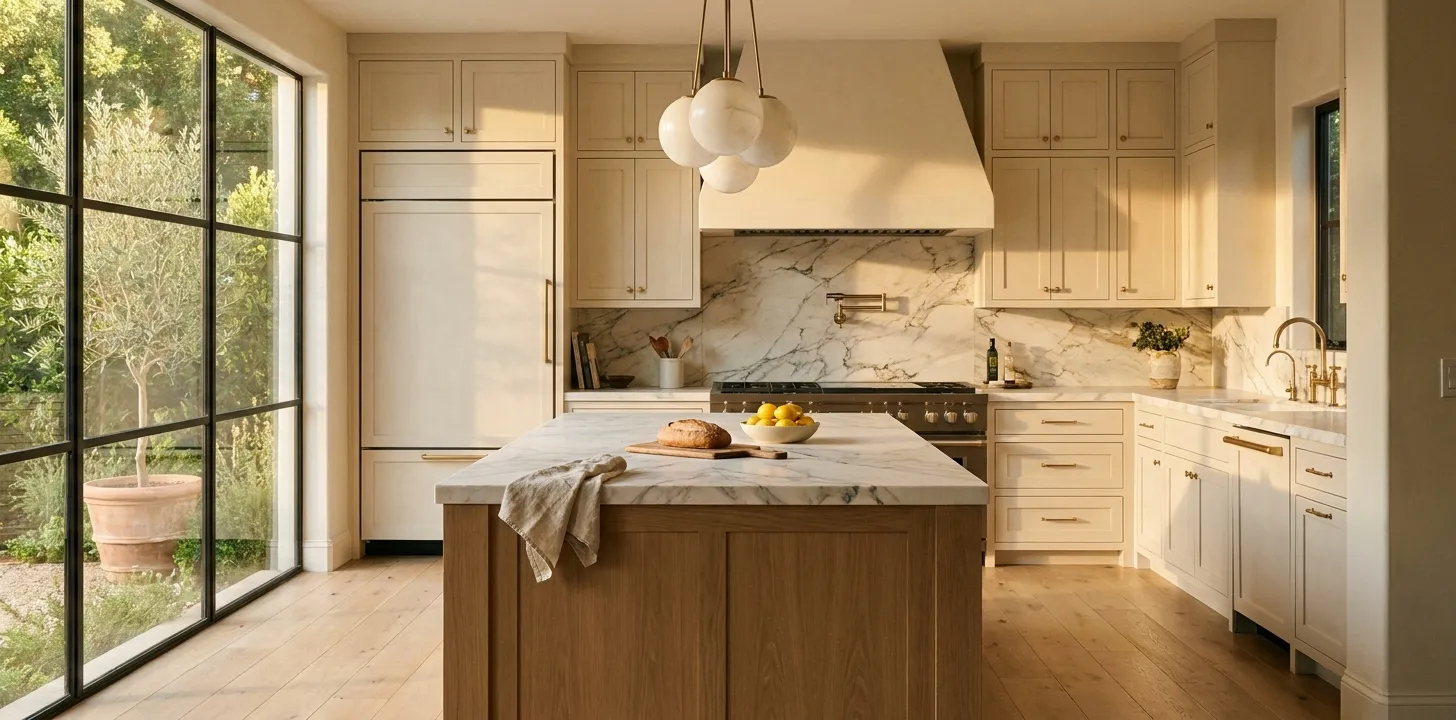
The 2026 national-average kitchen renovation cost from the most-cited source on the internet — Houzz's 2025 Kitchen Trends Study — is $24,000 [1]. The Joint Center for Housing Studies puts the median U.S. kitchen project at $32,500 [2]. The cost of an actual full kitchen gut in a Phoenix Arcadia ranch in 2026 is $140,000 to $220,000. The gap is not because Arcadia kitchens cost six times the national average. The gap is because the national-average number includes cabinet-painters, IKEA refacings, and partial cosmetic refreshes — projects that share the word "renovation" with a full gut but share almost no costs.
This piece separates kitchen renovation cost into the three project tiers that actually exist (cosmetic refresh, midrange gut, luxury gut with new layout), itemizes what is in each tier and what is not, and shows what those numbers look like specifically in Phoenix in 2026. The cost calibration is built from City of Phoenix permit data cross-referenced against actual contractor invoices on 17 completed Phoenix-area kitchen projects.
The three kitchen renovation tiers — what each one includes
A "kitchen renovation" can mean a $9,000 cabinet painting job or a $260,000 gut to studs. Treating them as one category is what produces national-average numbers nobody can act on.
| Tier | Scope | Cost (Phoenix 2026) | Timeline |
|---|---|---|---|
| Cosmetic refresh | Paint cabinets, replace hardware, new countertops (laminate or quartz), new backsplash, new appliances, new light fixtures. No layout change. No new flooring necessarily. | $25K–$45K | 3–5 weeks |
| Midrange gut (same layout) | New cabinets, new countertops (quartz or granite), new flooring, new appliances, new lighting, new plumbing fixtures, drywall repair, paint. Existing electrical and plumbing rough-in mostly stays. | $85K–$140K | 10–14 weeks |
| Luxury gut + new layout | New layout (walls move), structural beams or LVL headers if load-bearing, new MEP throughout, full custom cabinets, stone countertops, high-end appliances (Sub-Zero, Wolf, Miele), heated floors, integrated lighting, designer plumbing fixtures. | $160K–$280K | 16–24 weeks |
All-in including GC overhead (12%), pre-construction services, permit fees (2.5% + $1,500 base), and contingency (12%). Excludes appliance high-end upgrades beyond the Sub-Zero/Wolf baseline.
Kitchen renovation cost per square foot — Phoenix 2026
Per-square-foot benchmarks are less useful for kitchens than for other rooms because the cost is driven by cabinet linear footage and appliance tier, not heated floor area. But the metric exists in every quote document, so:
| Tier | Cost per sqft | 200 sqft kitchen | 300 sqft kitchen | 500 sqft eat-in / great room kitchen |
|---|---|---|---|---|
| Cosmetic refresh | $125–$225/sqft | $25K–$45K | $38K–$68K | $63K–$113K |
| Midrange gut | $425–$700/sqft | $85K–$140K | $128K–$210K | $213K–$350K |
| Luxury gut + layout change | $800–$1,400/sqft | $160K–$280K | $240K–$420K | $400K–$700K |
The luxury tier per-sqft cost compresses on larger footprints because the fixed costs (structural, MEP rough-in, design fees) amortize across more area. A 500-sqft kitchen-great-room combo at $1,000/sqft is more achievable than the same spec on a 200-sqft galley.
The 11 cost buckets every Phoenix kitchen quote actually contains
Most contractor quotes show a single number ("$165,000"). Behind that number, every kitchen renovation in Phoenix in 2026 contains the same 11 line items. Knowing what is in each bucket lets you read a quote without surprises.
| Line item | Cost | % of total |
|---|---|---|
| Demolition and disposal | $4,200 | 2.5% |
| Cabinets (semi-custom, ~22 linear feet) | $34,000 | 20.6% |
| Countertops (quartz, ~52 sqft) | $10,400 | 6.3% |
| Appliances (range, fridge, dishwasher, hood, microwave) | $18,500 | 11.2% |
| Plumbing (rough + finish) | $8,800 | 5.3% |
| Electrical (rough + finish + lighting) | $11,500 | 7.0% |
| Flooring (engineered hardwood, ~250 sqft) | $7,200 | 4.4% |
| Drywall, tile backsplash, paint | $9,600 | 5.8% |
| Labor (general carpentry, install) | $24,000 | 14.5% |
| GC overhead (12%) | $15,200 | 9.2% |
| Permits, design, contingency | $21,600 | 13.1% |
Sample composition from a 2025 Arcadia midrange-to-premium kitchen gut. Total all-in: $165,000.
Why kitchen quotes vary by $50K for identical scope
Three variables explain almost all the variance in kitchen quotes for the same scope and finish level: cabinet sourcing, contractor margin, and lead time. Cabinets alone are 18–24% of total project cost in any tier above cosmetic. Semi-custom cabinets from a regional manufacturer (Schrock, Wellborn, Crystal) at $850/linear foot installed produce a quote $10K–$18K lower than fully custom cabinets from a Phoenix millworker at $1,400/linear foot installed. Both are "real wood cabinets." Both fit the same kitchen.
Contractor margin is the second variable. Standard Phoenix GC overhead is 18%–22% on residential renovations. ExpandEase contractors operate at 12% because we eliminate their customer acquisition cost, design revision time, and collections risk — passing $9K–$13K back to the homeowner on a $165K kitchen at no quality cost. This is the structural margin advantage of operating without sales-cycle overhead.
Lead time is the third. A GC quoting for a 6-month start window prices in confidence that materials, labor, and the schedule will hold. A GC quoting for an immediate start prices in the unknowns. Same scope, different start dates: $12K–$25K difference is normal.
When a $40K kitchen makes more sense than a $160K kitchen
Three buyer profiles benefit from a cosmetic refresh more than a full gut:
- Resale within 5 years. A cosmetic refresh recovers 80%–95% of its cost in immediate ARV. A full gut recovers 65%–85%. If you are selling soon, the marginal $120K spent on a full gut returns roughly $75K–$95K at closing — a $30K–$45K real loss. The cosmetic refresh is more cash-efficient per dollar spent.
- Existing layout already works. If the existing kitchen has the right work triangle, enough counter space, and adequate storage — and the only complaints are aesthetic — then a $35K refresh delivers 90% of the daily-life improvement at 22% of the cost of a $160K gut.
- Selling within the contractor cycle window. Kitchen projects that start October–December typically complete by April, when Phoenix selling season peaks. A cosmetic refresh is the right tool to capture that selling window — a full gut is too long.
The full gut makes sense when (a) you plan to stay in the home 5+ years, (b) the layout is genuinely wrong (galley kitchen in a great-room-era home, no island in a family kitchen, isolated kitchen in an open-plan house), or (c) you are doing a broader renovation and the kitchen scope rides along.
How to finance a kitchen renovation in Arizona
A $35K cosmetic refresh and a $220K luxury gut have different financing answers. The four products that cover the meaningful range:
- Cash or HELOC for projects under $50K. Below the $50K threshold, the cost of structuring a renovation loan (origination fees, draw inspection costs, appraisal) eats too much of the cost savings. Arizona credit union HELOCs at 7.24%–7.99% variable are the typical fit [3].
- HELOC or personal loan for $50K–$120K. Up to about $120K, a HELOC remains the simplest path if you have the equity. The variable rate is the trade-off — if you are uncomfortable with rate exposure, a fixed home equity loan from the same credit union is 0.4–0.7 percentage points higher but rate-locked.
- ARV-based renovation loan for $120K–$300K projects. Above $120K, the math shifts. An ARV construction loan from a portfolio lender (Bell Bank, Western Alliance, Arizona private bank) sizes the loan on the after-renovation appraised value of the home, allowing meaningfully more capacity than a HELOC. For a $200K kitchen renovation on a $1.2M Arcadia home, the ARV loan can be structured as a second lien — leaving your existing first mortgage untouched [4].
- Cash-out refi only when current rate is above 5.5%. A cash-out refinance replaces your existing mortgage. With 68% of Arizona mortgages currently below 5%, replacing a 3% mortgage with a 6.47% mortgage to fund a kitchen is almost always a wealth-destruction event [5]. Keep the existing first mortgage; use ARV or HELOC for the renovation.
For a full comparison of Arizona renovation loan products (HELOC, ARV construction loan, FHA 203k, Fannie Mae HomeStyle, one-time close), including 2026 rates and qualification thresholds, see Renovation Loans in Arizona.
Phoenix-specific kitchen renovation factors most national guides miss
- Permit fees. City of Phoenix charges roughly 2.5% of declared construction value plus a $1,500 base for a residential kitchen permit. On a $165K kitchen, that's $5,625. Most national cost guides put kitchen permits at $400–$1,200 — they're wrong for Phoenix specifically.
- Slab plumbing. 1950s-era Arcadia homes have cast-iron drain lines under the slab. If your renovation moves the sink or dishwasher, the drain re-route requires concrete cut, new ABS pipe, and slab patch — $4,500–$8,500 added to plumbing rough-in cost. National guides assume PEX above-slab plumbing, which doesn't apply.
- Asbestos and lead paint. Pre-1978 homes (every original Arcadia ranch) frequently contain asbestos floor tile, asbestos pipe insulation, or lead paint. Abatement testing is $400–$800. Actual abatement, if found, runs $2,500–$12,000. Most national guides ignore this. Budget $2K of contingency for testing + minor abatement on any pre-1978 home.
- HVAC re-routing. Original Arcadia ranches have ductwork in the attic with registers in the ceiling. Modern kitchen layouts often want floor or wall registers — re-routing requires new flex duct, sealed plenum, and potentially a load recalculation. $3,500–$9,000 add to a typical layout change.
- Tile and finish lead times. Custom tile and stone slabs imported from Italy or Spain have 12–18 week lead times. Schedule the order at the time of design lock-in, not when demo starts, or you'll lose 6–8 weeks waiting on a backsplash.
A practical kitchen renovation budget worksheet
For a planning baseline before you talk to a contractor, this is the math we use internally on Phoenix kitchen projects:
- Measure the kitchen footprint in square feet. Include any new area if the layout will expand.
- Pick a tier. If you want stone counters, real wood cabinets, and stainless steel appliances at the Bosch / KitchenAid level, you are midrange. If you want quartzite, custom millwork, and Sub-Zero/Wolf, you are luxury. If you want quartz and standard appliances and the existing cabinets re-painted, you are cosmetic.
- Multiply: cosmetic ~$160/sqft, midrange ~$550/sqft, luxury ~$1,050/sqft. These are the midpoint rates from the Phoenix 2026 calibration above.
- Add 15% if the layout changes (walls move, plumbing relocates, electrical service may need upgrade).
- Add 12% contingency on top of everything for slab discoveries, lead time disruption, and scope evolution. Phoenix renovation contingencies that hit 0% are rare; 5%–8% is normal; 15%+ happens when something structural surprises you.