Add the space you need. Skip $60K+ in moving costs. See what's possible — free.
ADUs & Zoning
ADU Cost Phoenix 2026: Accessory Dwelling Unit Cost, Casita Cost & Detached Guest House Numbers
Every ADU cost number you've read online is a permit declared value — which is a fee-minimization number, not a project cost. Here's what a Phoenix ADU actually costs in 2026, broken down by line item.
By Kevin Philip, Founder, ExpandEase · Published · 10 min read
The most frequently cited ADU cost figure in Phoenix is around $187K — that's the median declared construction value on Phoenix detached ADU permits filed in 2025 [1]. It is also not what ADUs cost. Declared permit values systematically understate project cost because the permit fee scales with the declared number. The real all-in cost for a median 612-sqft Phoenix detached ADU is closer to $270K–$295K. Understanding the gap matters before you request a single contractor quote.
The six cost buckets in every ADU quote
Hard construction is what the permit application captures: foundation, framing, MEP rough-in, insulation, drywall, roofing, and finishes. It's the number everyone publishes. The other five buckets are where quotes diverge and where projects blow up.
Site and utility work: the hidden $22K–$35K
Every detached ADU in Phoenix needs its own sewer lateral — a new connection from the unit to the city main, typically running 40–80 linear feet across the lot. Cost: $8K–$15K depending on depth and soil conditions. It also typically triggers a utility easement recording ($500–$1,500) and often requires an electrical service upgrade to the main panel to support the additional load ($4K–$9K). These three items alone add $22K–$35K that has nothing to do with the unit's square footage and nothing to do with how the contractor prices the structure itself.
This is the single most common reason ADU quotes look wildly different for identical footprints. One contractor quotes including site work. Another quotes excluding it. The homeowner gets two bids that look $30K apart and assumes one contractor is overcharging. They're often the same number.
Pre-construction services: the line nobody talks about
Before a shovel moves, a detached ADU in Phoenix needs architectural drawings (2–3% of construction cost), an engineering stamp, a building permit application (fee: $3K–$5K for a $165K project), and HOA approval if applicable. These costs run $12K–$21K depending on unit size and typically aren't included in the GC's base bid. Pre-construction services are the primary cause of the timeline extension most homeowners don't anticipate — permitting for a detached ADU in Phoenix takes 90–150 days on average [1].
What size ADU should you build?
The most financially efficient ADU in Phoenix is 500–700 sqft. Below 500 sqft, the fixed site costs ($25K+) dominate — your effective cost-per-sqft on a 400-sqft unit runs $470–$510 because you're paying the same sewer lateral and service upgrade as a 800-sqft unit. Above 800 sqft, you're adding bedrooms and bath count that meaningfully increase hard construction cost but don't produce proportional rental income in Phoenix's current market.
ADU cost by size — Phoenix 2026, premium quality all-in
Size
All-in cost range
Effective $/sqft
Est. monthly rent
Gross rent yield
400 sqft (studio)
$165K–$195K
$415–$490
$1,450–$1,700
10.5%–11.0%
600 sqft (1 bed / 1 bath)
$250K–$300K
$415–$500
$1,800–$2,100
8.6%–9.0%
800 sqft (2 bed / 1 bath)
$330K–$400K
$415–$500
$2,100–$2,500
7.5%–8.5%
1,000 sqft (2 bed / 2 bath)
$405K–$495K
$405–$495
$2,400–$2,900
7.0%–8.5%
Rent estimates based on Phoenix Rental Authority Q1 2026 data for detached accessory units. Gross rent yield = annual rent ÷ all-in cost. Does not account for vacancy, maintenance, or management.
ARV impact: what does an ADU add to your home's value?
Appraisers in Maricopa County value detached ADUs using the income approach (capitalized rental income) and the cost approach (depreciated replacement cost), then weight them against comp sales of properties with and without ADUs [2]. In practice, a well-constructed 600-sqft detached ADU in a desirable Phoenix ZIP adds $180K–$250K in appraised value. At an all-in cost of $250K–$300K, the equity math is approximately break-even to modestly negative on immediate ARV — but the rental income ($1,800–$2,100/month) converts an $80–$90K "equity gap" into a break-even in 4–5 years.
What a realistic timeline looks like
Based on 84 Phoenix ADU permits finaled in 2025, the median timeline from permit application to final inspection was 9.5 months [1]. The distribution was heavily right-skewed: the fastest 10% took 4–5 months (straightforward sites, experienced GC, no HOA), and the slowest 10% took 15–19 months (soil issues, structural revisions, slow HOA). Budget 10–12 months from permit application to occupancy for planning purposes. If your GC quotes 5 months, ask to see their last three finaled permits.
Frequently Asked Questions
What is an accessory dwelling unit?
An accessory dwelling unit (ADU) is a self-contained secondary residential unit on the same lot as a primary single-family home, with its own kitchen, bathroom, and sleeping area. In Phoenix, ADUs can be detached (a separate structure, often called a casita or guest house), attached (sharing a wall with the main home), or interior (a converted garage, basement, or carved-out portion of the main home). The City of Phoenix legalized ADUs by-right on most R-1 lots in 2023, and 84 detached ADU permits were finaled in 2025.
What is the average accessory dwelling unit cost in 2026?
Nationally, accessory dwelling unit cost averages $150K–$400K depending on market and unit type, but the range is wide because labor costs, site work requirements, and permit/impact fees vary enormously by city. In Phoenix specifically in 2026, a 600-sqft detached ADU runs $250K–$300K all-in ($415–$500/sqft). A garage conversion to an ADU runs $110K–$190K. Prefab ADU options reduce on-site labor but still require site work (sewer lateral, electrical) at full Phoenix labor rates, so the all-in cost lands $30K–$60K below custom-built but with less design flexibility.
How much does a casita cost to build in Arizona?
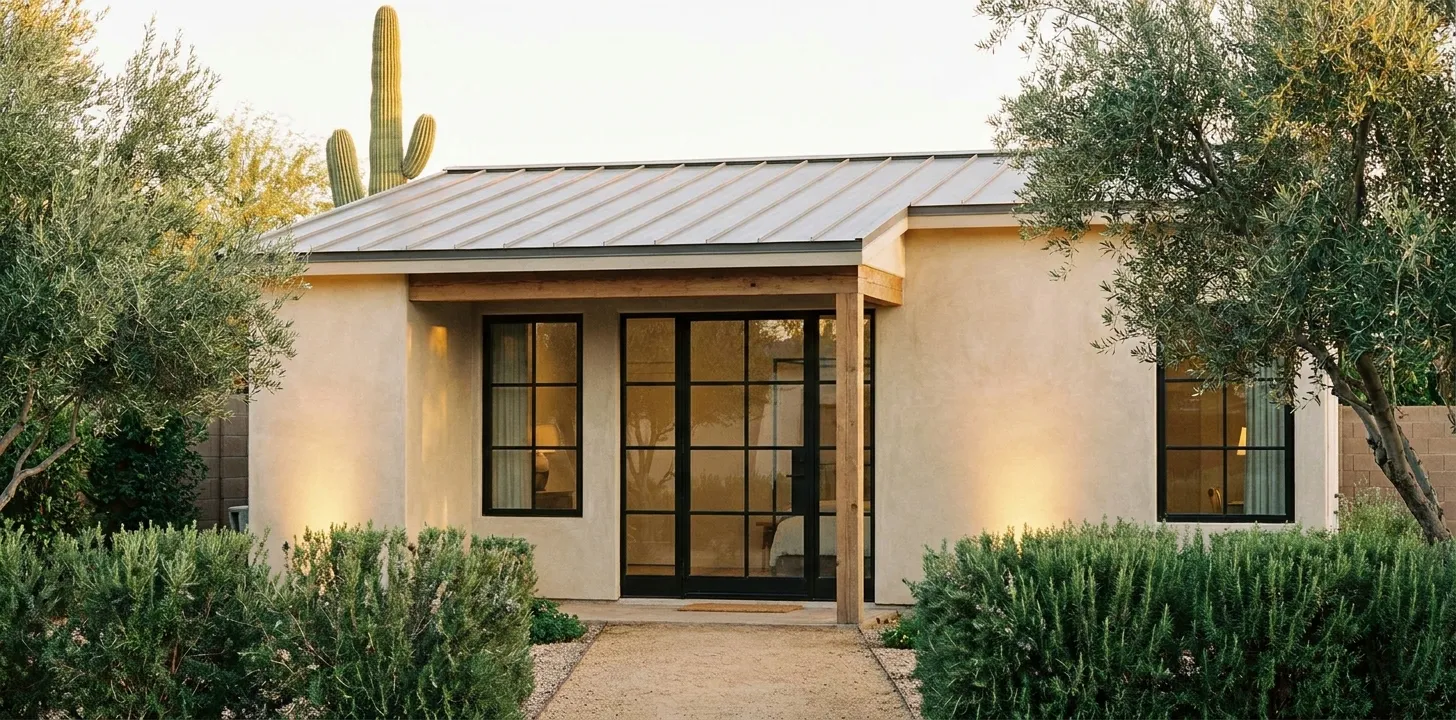
In Arizona in 2026, a casita (the locally-used term for a detached guest unit) typically costs $250K–$310K all-in for a 600-sqft unit at midrange-to-premium quality. Casita cost matches detached ADU cost because they are the same construction product — the distinction is naming convention, not building practice. The Spanish-style architecture common in casita designs typically adds $15K–$25K in finish premium (tile roof, stucco detailing, wrought iron) but does not change structural cost. Garage-to-casita conversions are the lowest-cost path at $110K–$190K.
How much does an ADU cost in Phoenix in 2026?
A 600-sqft detached ADU in Phoenix costs $250K–$300K all-in in 2026, or roughly $415–$500/sqft. That's meaningfully higher than the $165K median declared permit value because permits capture only hard construction — they exclude site work ($22K–$35K), GC overhead (12%), pre-construction services, and contingency (12%). The permit-declared number is a fee-minimization figure, not a project cost.
What size ADU is most cost-efficient in Phoenix?
A 500–700 sqft detached ADU is the sweet spot in Phoenix. Units below 500 sqft pay the same fixed site costs ($25K+ for sewer lateral and electrical) as larger units, driving up effective $/sqft. Units above 800 sqft add bedrooms and bathrooms at full $/sqft rates but don't generate proportional rental income increases in Phoenix's current market.
Does an ADU add value to your home in Phoenix?
A well-constructed 600-sqft detached ADU in Phoenix adds $180K–$250K in appraised value. At a $250K–$300K all-in build cost, the immediate equity math is approximately break-even. The more compelling case is rental income: $1,800–$2,100/month at 8.6–9.0% gross yield makes the ADU one of the best-yielding residential assets available in Phoenix at current construction costs.
How long does an ADU take to build in Phoenix?
Based on 84 permits finaled in 2025, the median Phoenix ADU timeline from permit application to final inspection was 9.5 months. The fastest projects (straightforward sites, experienced GCs, no HOA) took 4–5 months. Budget 10–12 months for planning purposes.
Can I finance an ADU in Phoenix?
Yes. The most common financing vehicle is an ARV-based renovation loan (construction-to-perm or second-lien ARV product) that lends against the completed value of the property including the ADU, not just your current equity. This is the key structural difference from a traditional HELOC — you're borrowing against future value, which makes the math work even for homeowners with limited current equity.
Can you build an ADU in Phoenix?
Yes. Phoenix legalized ADUs by-right on most single-family (R-1) lots in 2023, and Arizona's HB 2720 extended ADU access statewide effective January 1, 2025. The City of Phoenix permits up to two accessory dwelling units on most single-family detached lots in addition to the primary home, subject to lot-size, setback, and height limits that vary by zoning district and any HOA. As proof the path is real, 84 detached ADU permits were finaled in Phoenix in calendar year 2025, with a median timeline of about 9.5 months from application to final inspection.
8 real ADU floor plan configurations for Phoenix: 320-sqft studio through 1,000-sqft 2-bedroom. Real costs, ARV impact, rental income potential, and which floor plan fits which lot.
A casita is the most searched ADU term in Arizona — and the most mis-quoted. Here is what a Phoenix casita actually costs in 2026 by size, finish level, and construction method, plus how HB 2720 changed the permitting math.
A Phoenix-specific renovation cost calculator backed by 2026 permit data and real contractor quotes — not Zillow averages. Six project types, three quality tiers, manufactured equity math included.
Three ways to add a guest house in Phoenix — attached addition, detached structure, garage conversion — with real 2026 cost ranges by size, the ARV impact of each, and why the cheapest option isn't always the best financial decision.
Convert to bedroom or office: $45K–$95K. Convert to ADU with bath and kitchen: $110K–$190K. Upgrade carport to enclosed garage: $24K–$58K. The full math, calibrated to Phoenix 2026.
Phoenix recorded 84 detached ADU permits in 2025. Median size 612 sqft. Median construction value $187K. The longest one took 19 months from permit to final inspection. The shortest, 4. The pattern in the data is more interesting than the averages.
Arizona has more renovation loan products than most homeowners know exist. The differences between them — in cost, flexibility, and how much they fund — are large enough to change whether a renovation is financially viable.