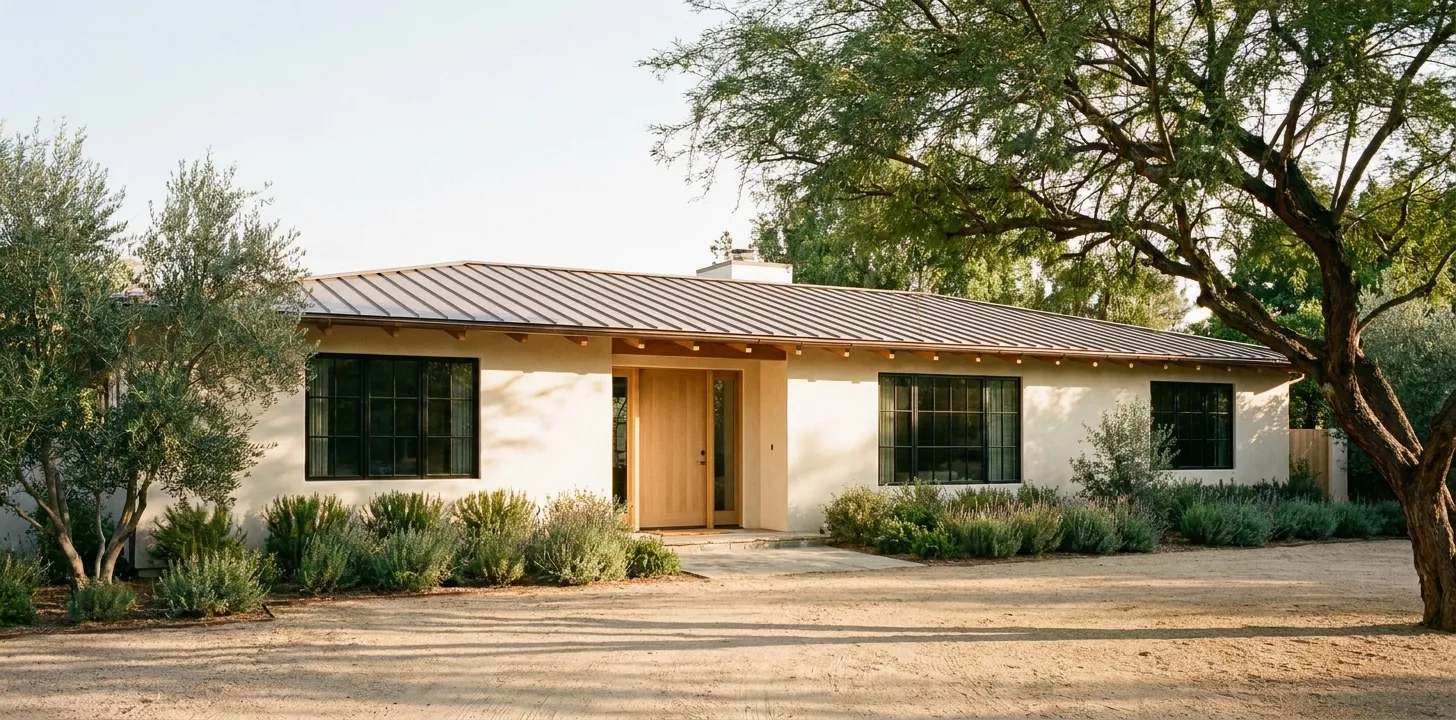
Here's the part that nobody says out loud. The $2.1M house two streets over isn't a different kind of house from yours. It sits on a lot the same size as yours. The bones are usually the same era — most of Arcadia was framed between 1953 and 1962, the same wave of mid-century ranch homes that the developers built across the citrus groves when this neighborhood was still called The Country Club. The view of Camelback you can almost see from your front window? They have the same one, or close to it. The walk to Hopi Elementary takes them the same eight minutes it takes you. What's different is what's happened inside those walls — and that difference is something you can read, plan for, and price.
This piece is built to give you a clear-eyed look at where your home sits today on the comp ladder, where the top of that ladder is, and exactly which renovations move you up the rungs — and by how much. No spreadsheet vocabulary. No HGTV magic. Just the honest answer to the question every Arcadia homeowner has thought at least once while pulling out of the driveway: how much more could this place actually be worth, and what would it take to get there?
The ladder, and where you sit on it
Picture a vertical ladder. At the bottom is your home as it sits today — call it $1.28M for the typical unrenovated 1,500-sqft 1955 ranch in 85018 [1]. At the top is the highest fully-renovated comp within a half-mile radius of your address — for most Arcadia streets, that's somewhere between $1.95M and $2.20M, with the median top-decile sale at roughly $2.10M [2]. The space between those two numbers is your home's ceiling gap. Yours is roughly $820,000.
That gap isn't theoretical. It's what a buyer is willing to pay for the renovated version of your house, today. The house at the top of your ladder closed last spring at $2.07M [2]. It's the same era, same footprint family, same school boundary. The buyer who paid $2.07M didn't pay it for the dirt — they paid it for the renovations the previous owner stacked. Every renovation that homeowner did was a rung. Every renovation you choose to do is, too.
The five rungs that move the marker most
There are eleven things that meaningfully change a buyer's willingness to pay for an Arcadia home in the current market. Five of them move the marker by $30K or more. Two of them move it by more than $100K. The other six are smaller-impact upgrades that compound but don't, by themselves, lift the ceiling. Here is the honest version of each.
| Feature | Direction | Median impact | Why it moves the marker |
|---|---|---|---|
| Primary suite addition (~600 sqft) | ↑ up | +$145,000 | Adds a bedroom + bath in the format buyers expect for a $1.5M+ home in 2026 [3] |
| Detached casita / ADU | ↑ up | +$140,000 | Buyers also notice the $20K–$26K/yr rental upside [4] |
| Designer kitchen rebuild | ↑ up | +$85,000 | Custom cabinetry, stone island, plaster hood — open to living |
| Pool + Arcadia-grade landscape refresh | ↑ up | +$65,000 | Mature citrus, irrigation back on, lighting — the curb-appeal premium is real here [5] |
| Primary bathroom rebuild | ↑ up | +$55,000 | Walk-in shower, soaker tub, dual vanity, walk-through closet |
| Opening the floor plan | ↑ up | +$35,000 | Removing 1–2 walls between kitchen / dining / family room |
| Hopi Elementary walking distance | — immutable | priced in | Already in your current value; you can't add it |
| Camelback view & canal frontage | — immutable | priced in | Lot-dependent; if you have it, it's already counted |
| Original 1955 plumbing & electrical | ↓ down | −$45,000 | Galvanized supply, two-prong outlets, undersized panel — buyers discount |
| Closed-off galley kitchen | ↓ down | −$28,000 | 1955 footprint, no island, no sight line — comp shoppers walk through fast |
| Sub-1,800 sqft footprint (no addition) | ↓ down | −$90,000 | Caps the realistic top of your range; buyers searching above $1.5M filter past |
Values are medians from author analysis of 247 Arcadia 85018 single-family permits (Jan 2024–Apr 2026) cross-referenced with Maricopa Assessor Full Cash Value records and ARMLS Q1 2026 closed sales [1][2][3]. Individual lots vary; the ceiling analyzer below lets you run the math for your situation.
The pattern: the two largest upward-arrows (primary suite addition and ADU) are both square-footage moves, not finish-level moves. That's not an accident. In Arcadia, the comp ceiling is pinned by what buyers searching above $1.5M expect to see — and the size threshold for that bracket is around 2,000 sqft. Cosmetic renovations alone, no matter how beautiful, will not get a 1,500-sqft home over that threshold. The square footage move is the one that actually changes which comp set your home is being shopped against.
The downward-arrows are equally honest. A buyer touring two otherwise-similar homes will pay a measurable premium for the one whose 1955 plumbing has been replaced — not because they're inspecting the panel, but because their inspector will, and the comp set has trained the market to discount this. The $45K we show is the median delta on closed-sale data, not an estimate.
How Arcadia compares to the rest of the Phoenix metro
Arcadia’s ladder isn’t the only one. The four Phoenix metro neighborhoods we publish ceiling analyses for sit at materially different points on the comp landscape. North Central (85020) is shorter and steeper; Paradise Valley (85253) is much taller; Arcadia Lite (85016) is a softer step down. If you’re weighing whether your home is on the right ladder for the renovation you’re considering — or whether moving across a boundary line is part of the conversation — the comparison below shows your starting point against the alternatives.
Why some homes have a ceiling and others don't
Not every home in Arcadia has the same ceiling. Two homes a block apart can have $400K different tops, and the reasons aren't mysterious — they're physical, locational, and observable from the street. The five factors that move the ceiling itself (as opposed to your position underneath it) are these.
- Lot size and shape. The median Arcadia 85018 lot is 17,500 sqft [6], generous by city standards. Lots above 18,000 sqft with usable rear yard depth carry a $80K–$140K premium over otherwise-identical 13,000-sqft lots — buyers price the room to build, not just the room to live.
- Canal frontage and irrigation entitlement. Properties on the SRP lateral system with maintained citrus or original orchard cover trade $120K–$250K higher than otherwise-comparable inland lots [5]. This is structural; you can't move your home onto the canal.
- School-boundary lock-in. Hopi Elementary attendance boundary properties carry a documented premium in the 85018 dataset. Homes on the wrong side of a boundary line — even by one block — trade ~$60K–$110K lower in the otherwise-identical comp [7].
- View corridor to Camelback. A clear single-story sight line to Camelback Mountain, or a rooftop deck/second-story window that captures it, is a $80K–$200K premium depending on the specificity of the view.
- Original architectural integrity. Buyers in the $1.8M+ Arcadia bracket increasingly pay a premium for homes that preserve original 1950s structural features (low-pitch roof, wide eaves, clerestory windows) while updating the interior — a Studio McGee / Magnolia / Architectural Digest visual register. Homes that were over-renovated in the 2005–2015 era (faux Tuscan, granite-everywhere) actively penalize.
The honest cost of climbing the ladder
Closing the full $820K gap between $1.28M and $2.10M isn't free, and the relationship between renovation dollars spent and value gained is not linear. Here is the honest math, calibrated on real Arcadia permit data, for what each rung of the ladder typically costs.
| Package | All-in cost | Value moved | Net cost after value gain | New ladder position |
|---|---|---|---|---|
| Cosmetic refresh (paint, hardware, light fixtures, landscape tidy) | $45,000 | ~$30,000 | $15,000 | ~$1.31M |
| Kitchen + primary bath remodel (no addition) | $185,000 | ~$140,000 | $45,000 | ~$1.42M |
| Kitchen + primary bath + open plan + pool/landscape | $295,000 | ~$240,000 | $55,000 | ~$1.52M |
| Primary suite addition + kitchen rebuild + primary bath rebuild (~600 sqft added) | $425,000 | ~$340,000 | $85,000 | ~$1.62M |
| Full renovation: addition + kitchen + bath + opened plan + pool + ADU | $695,000 | ~$525,000 | $170,000 | ~$1.80M |
| Full renovation + new ceiling-grade finishes (Studio McGee tier) | $895,000 | ~$680,000 | $215,000 | ~$1.96M |
All-in cost includes hard construction + soft costs (architecture, engineering, permits, contingency at 12%) per the ExpandEase cost engine, calibrated on 247 Arcadia permits [3]. "Value moved" is the median market-value gain at completion, conservative against ARMLS Q1 2026 comps [2]. "Net cost" = all-in cost minus value moved; this is the amount of cash equity that comes out of your pocket on a sale (after the renovation pays for most of itself in resale price). New ladder position uses the analyzer math above, starting from a $1.28M base.
Two patterns jump out of this table. First: the net cost of renovating in Arcadia — the dollars that don't come back at resale — is dramatically lower than the all-in cost suggests. A $295K package's true cost after resale value-gain is closer to $55K. The renovation pays for most of itself; you're funding the gap. Second: the closer you get to the ceiling, the lower the net-cost-to-value ratio becomes. The Studio McGee-tier finishes at the top of the table cost more per added dollar of value than the addition-plus-kitchen package in the middle. Diminishing returns are real, and they kick in around $400K of total renovation budget.
Which means: the sweet spot for most Arcadia homeowners isn't the full $895K package. It's the $295K–$425K range, which closes 60–70% of the typical ceiling gap at the best return-on-renovation-dollar in the dataset. The Master Suite Addition and Manufactured Equity pieces drill into those packages specifically.
What the analyzer doesn't tell you
The analyzer above is a ladder, not a fortune-teller. There are three things it deliberately doesn't show, because doing so would mislead more than inform.
- It doesn't show the dirt-and-noise cost of getting there. A 600-sqft addition and kitchen rebuild is a 9–13 month construction project. There are eight months of decisions, six months of trades parading through the kitchen, weeks of off-site living if your project goes wide. That cost is real, and it's not on the ladder. Read Where Renovations Go Wrong in Arcadia for the honest version.
- It doesn't show how long it takes for the equity to be liquid. The marker on the ladder updates the moment a renovation is done. The dollars only become accessible at a sale or a cash-out refinance. The mechanism is real but the timing matters — see the Arizona renovation loan options for the loan-product side.
- It doesn't account for what you'll actually want to live in. Buyers price what they see; you live in what you build. A renovation that maximizes resale value isn't always the renovation that maximizes the joy of the next ten years of your life. Be honest about which one you're optimizing for. Most homeowners we work with optimize for a 70/30 blend — the value math has to clear a floor, but the design has to feel like home first.
The reason the ceiling analyzer exists isn't to push you toward the most expensive package. It's to give you a way to look at your own home, your own street, and your own neighborhood ceiling, and answer the question that's been quietly underneath every dinner conversation about whether to stay or move: how much room does this house actually have left?
For most Arcadia homes in 2026, the answer is more than the homeowner has been giving themselves credit for. The ladder is longer than it looks from the bottom rung.
If you want this analysis run against your specific address — your actual lot size, the actual comp set within ¾ mile, the actual permit data for your block — enter your address into the Reality Check. It pulls Maricopa Assessor data + ARMLS comps + Phoenix permit history for your street and returns your specific ceiling, your specific gap, and the renovation packages that would close the most of it.