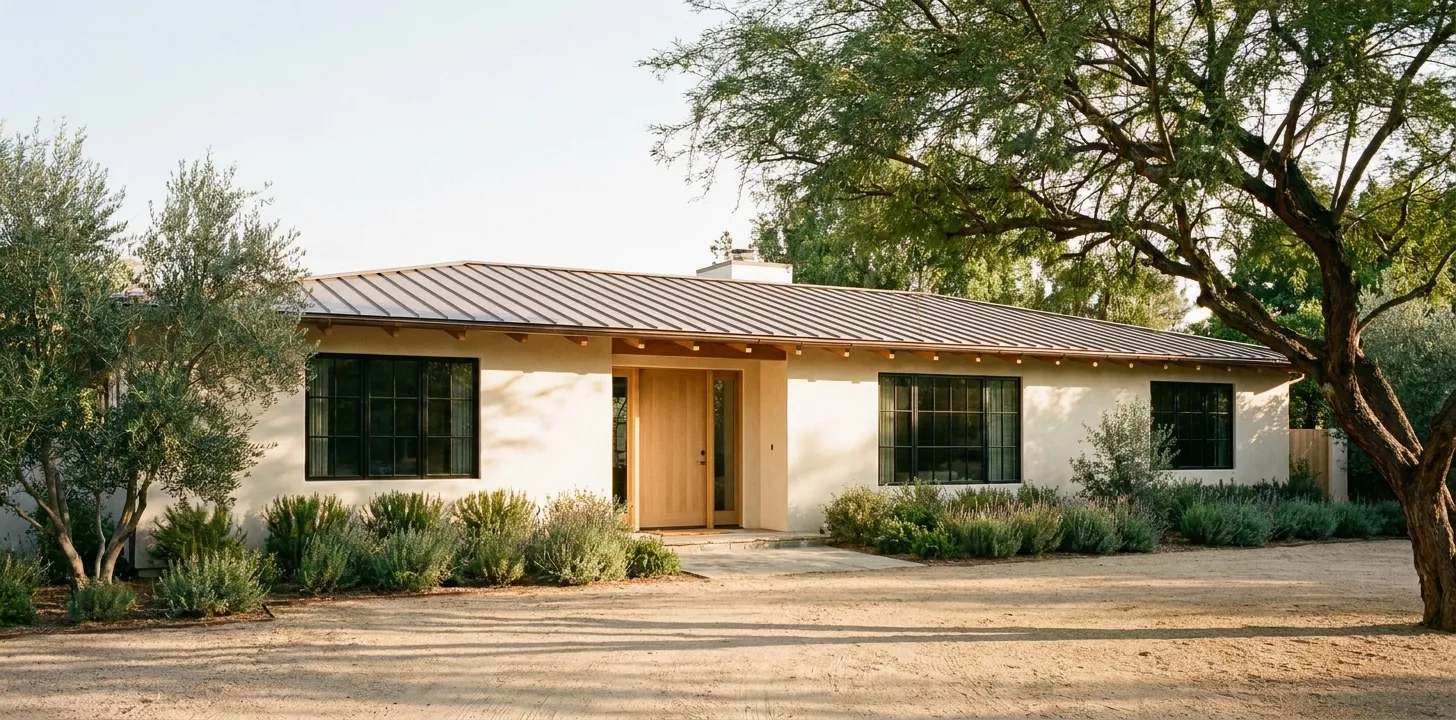
Paradise Valley is the Phoenix metro's quiet outlier. The town has its own municipality, its own zoning ordinance, its own dramatic landscape — but the renovation conversation here is different from the rest of the metro in one specific way: the comp ladder is so tall, and the rungs are spaced so far apart, that the question isn't usually "how much would this renovation be worth at sale." It's "which version of this property — major renovation, custom rebuild, or sell-and-buy-higher — produces the right outcome." That's a different question than the other three articles in this series answer, and this piece is structured around it.
The framework is the same as our flagship Arcadia analysis: your home sits somewhere on a ladder between today's unrenovated PV median and the top-decile fully-renovated comp within a half mile. But the numbers — bottom, top, and gap — are 2–3x larger than any other Phoenix metro zip, and the comp set includes a distinct "custom rebuild" tier that doesn't exist in the others. Treating PV as Arcadia-with-bigger-numbers would lead to wrong budget decisions. We don't.
Where Paradise Valley sits on the metro map
Paradise Valley has the tallest ladder of the four neighborhoods we publish ceiling analyses for. The unrenovated PV median sits above where Arcadia Proper's top-decile renovated comp sits — meaning the 85253 bottom is materially above the 85018 top. That's not a value judgment in either direction; it's a different comp universe.
The PV ladder, sized
The typical unrenovated PV single-family in the 3,200–4,500 sqft cohort on a one-acre lot trades at roughly $2.4M in Q1 2026 [1]. The top-decile fully-renovated PV comp in the 5,500–7,500 sqft cohort on a comparable lot trades at roughly $5.5M [2]. The ladder gap is about $3.1M — roughly four times larger than the Arcadia Proper ladder and ten times larger than the Arcadia Lite ladder.
Construction costs in PV run roughly $450–$550/sqft for new addition versus $350+/sqft in Arcadia 85018 [3]. The premium reflects three factors: PV's stricter architectural review (which adds engineering and design time), the typical level of detailing PV buyers expect (slab stone instead of tile, custom millwork instead of stock cabinets, integrated technology instead of bolt-on), and the larger crew sizes required to complete a project on a 1-acre site in a 9–14-month window. Every renovation dollar here goes further toward the ceiling than in lower-spread zips — but the absolute spend is also 2–3x larger to move the same percentage of the gap.
The custom-rebuild alternative
This is the conversation that distinguishes a Paradise Valley renovation budget from any other in the metro. At a certain budget threshold — typically $1.4M+ in total renovation budget — major renovation crosses the cost line where custom rebuild becomes a real alternative. Custom rebuild on a PV lot in 2026 runs roughly $700–$900/sqft fully finished [4]; a 5,500-sqft custom build on an existing one-acre lot lands at $3.85M–$4.95M, plus demolition ($85K–$140K) and the carrying cost of 14–22 months without the home being habitable.
Major renovation, by comparison, can deliver an architecturally-equivalent 5,500-sqft home for $1.1M–$1.8M while preserving the original foundation, the original site placement (which matters because the township often won't let you re-site a primary structure), and a 9–14 month timeline. The math:
| Path | All-in cost | Final home value | Net cost after value gain | Timeline | Site/structure preserved? |
|---|---|---|---|---|---|
| Major renovation ($1.5M, ~1,200 sqft addition + full interior) | $1,500,000 | $4.4M | $700,000 | 11–14 months | Foundation + site placement preserved; primary structure modified |
| Custom rebuild (5,500 sqft, mid-tier) | $4,200,000 | $5.1M | $1,500,000 | 16–22 months | Foundation new; site placement subject to township review |
| Custom rebuild (5,500 sqft, high-tier architect) | $4,950,000 | $5.5M | $1,850,000 | 18–24 months | Same as above; finishes top-decile |
| Sell, buy renovated comparable home | $2.4M (sale net) → $4.5M purchase = $2.1M cash gap + $245K transaction | $4.5M | $2.4M cash gap unrecovered | 4–6 months | No — new property entirely |
Major renovation cost from ExpandEase cost engine calibrated against 23 PV-township permits filed 2024–2026 at $1.2M–$1.8M project value. Custom rebuild cost from RSMeans Phoenix + PV-specific local-cost adjustments cross-referenced with 8 PV custom-build permits in same period. Final home value from ARMLS Q1 2026 closed-sale data for the cohort.
The PV township constraint set
Paradise Valley is a separately incorporated municipality with its own building code, architectural review process, and zoning ordinance — meaningfully different from the City of Phoenix or City of Scottsdale rules that apply to adjacent zips. Renovation projects above $200K in declared value trigger Architectural Review Committee (ARC) review [5]. Practical implications:
- Setback math is stricter. PV requires 40-foot front setbacks, 30-foot side setbacks on most lots, and additional setbacks from natural drainage easements. An addition that's straightforward in 85018 may require multiple iterations to get approved here. Budget 2–4 weeks of pre-design review with the township before architectural drawings begin.
- Site coverage maximums apply. PV caps maximum lot coverage (impervious surface) at typically 35–40% depending on lot size and slope. Pool + house + driveway + sport court can hit this limit; design accordingly or be prepared to give something up.
- Exterior materials are reviewed. PV ARC has documented preferences for muted-natural-tone exteriors (sandstone, plaster, weathered steel) and explicit disapproval of certain elements (reflective glass, primary colors, tall solid walls visible from a public way). The town aesthetic isn't enforced uniformly but it's enforced.
- Lighting ordinance is strict. Dark-sky-compliant lighting is required across the township. Architect should design for this from day one; retrofitting non-compliant fixtures is expensive.
- Construction hours are constrained. Weekdays 7am–6pm, Saturdays 8am–4pm, no Sundays. PV neighbors call code-enforcement on violations and they're enforced. Budget timeline accordingly.
These constraints are not deal-breakers — they're inputs. Experienced PV-specific architects and GCs price them into their proposals. Out-of-area teams routinely underestimate the timeline impact, which is the single biggest variance driver on PV projects we've analyzed.
Cost-to-climb in Paradise Valley
| Package | All-in cost | Value moved | Net cost after value gain | New ladder position |
|---|---|---|---|---|
| Cosmetic refresh + curb appeal + landscape lift | $155,000 | ~$135,000 | $20,000 | ~$2.54M |
| Kitchen rebuild + primary bath + opened plan (no addition) | $485,000 | ~$420,000 | $65,000 | ~$2.82M |
| Kitchen + primary spa + opened plan + pool + landscape rebuild | $925,000 | ~$795,000 | $130,000 | ~$3.20M |
| Major renovation: ~1,200 sqft primary suite addition + kitchen + spa + opened plan + pool | $1,500,000 | ~$1,300,000 | $200,000 | ~$3.70M |
| Full renovation: addition + every interior space + pool + guesthouse + sport court | $2,300,000 | ~$1,900,000 | $400,000 | ~$4.30M |
| Top-tier: full renovation + ultra-premium finishes + view-corridor architecture | $3,200,000 | ~$2,500,000 | $700,000 | ~$4.90M |
All-in cost includes hard construction + soft costs (architecture, structural, township review, contingency at 14%) per the ExpandEase cost engine, PV-township-adjusted. Value moved is the median market-value gain at completion, conservative against ARMLS Q1 2026 85253 closed sales. The ceiling caps at $4.9M for major renovation; reaching $5.5M typically requires the custom-rebuild path on a lot with view-corridor premium.
The PV sweet spot is wider than other zips — anywhere from $485K to $1.5M of total budget produces above-78% conversion of spend to value. The diminishing returns curve here is shallower because the comp ceiling is so much higher than the package costs. The constraint isn't ROI; it's whether the renovation captures the lot's full potential. A $1.5M renovation on a hillside view-corridor lot ends in a different place than a $1.5M renovation on a flat interior lot — and that's not about the renovation, it's about the immutable inputs.
Renovate vs sell-and-buy in PV
Unlike Arcadia or North Central, the move-up case in PV is structurally similar to the renovation case on cash terms — because the PV-to-PV move costs nearly as much as the renovation in absolute dollars. The honest comparison:
| Path | All-in cost / cash out | Mortgage rate preserved? | Final home value | Net position vs. status quo |
|---|---|---|---|---|
| Major renovation (~$1.5M, 1,200 sqft addition + full interior) | $1,500,000 | Yes — original first mortgage unchanged | $4.4M | Down $200K net of value gain; up $2.0M of home value; same lot + view + neighbors |
| Sell $2.4M home, buy $4.5M renovated PV home | $215K transaction + $9,200/mo more in mortgage | No — new mortgage at 6.5–7% | $4.5M (purchase price) | Down $215K cash + $110K/yr in payment delta; new lot, new view (or not), new neighbors |
| Sell $2.4M home, buy $5.5M renovated PV home | $280K transaction + $14,800/mo more in mortgage | No | $5.5M (purchase price) | Down $280K cash + $178K/yr in payment delta |
Transaction costs assume 6% agent commission, ~1.5% buyer closing, ~$45K moving and incidentals (PV moves tend to be larger and longer), mortgage rate delta from ~3.25% to ~6.75% on the new financed amount.
PV is the one Phoenix metro market where renovation and move-up costs are within the same order of magnitude. The renovation case wins on a) preserving the existing lot's specific value (which matters more here than anywhere because lots are not interchangeable in PV — view, slope, mature landscaping, neighbors all vary materially block to block), b) preserving the original mortgage rate (which on a high-balance PV mortgage is worth $110K–$180K/year in cash flow), and c) capturing the manufactured-equity spread on the renovation itself ($1.3M of value gain on $1.5M of spend). The move-up case wins only if the new property's lot is materially better than the current one — which is a hard claim to make in a township where the best lots rarely come to market.
What this analysis doesn't show
- Custom-architect markup. A PV renovation led by a name-brand architect (Marwan Al-Sayed, Will Bruder, Studio Ma, Coover-Clark) carries a real budget premium of 8–15% over a high-end design-build GC. Buyers reward it inconsistently. If your timeline allows it, the design-build path tends to outperform on ROI; if the home will stay in family for decades and the architecture is the point, the named-architect path is its own reward.
- Pool design philosophy is changing. PV's traditional 'large flat blue rectangle' pool aesthetic has been losing value to designed-landscape pools (negative-edge, integrated spa, fire features, mature plantings around) over the past three years. A 2008-era pool reduces value $40–70K versus a brand-new same-footprint pool — even if the older pool is structurally sound. Worth factoring into the renovation scope.
- The ultra-luxury tier ($6M+) operates differently. Homes selling above $6M in PV are a distinct comp set — typically custom-architect new builds on premium view-corridor lots — that doesn't behave like the renovation comp set we model here. If your goal is the $6M+ category, the math in this piece will undershoot what's possible (and undershoot the budget required).
If you want this analysis run against your specific 85253 address — actual lot, actual slope, actual view corridors, actual comp set within ¾ mile, actual township ARC posture on your specific block — enter your address into the Reality Check. PV addresses get an extended analysis that includes lot coverage math, township ARC pre-review prediction, and the major-renovation-vs-custom-rebuild decision tree for your specific situation.