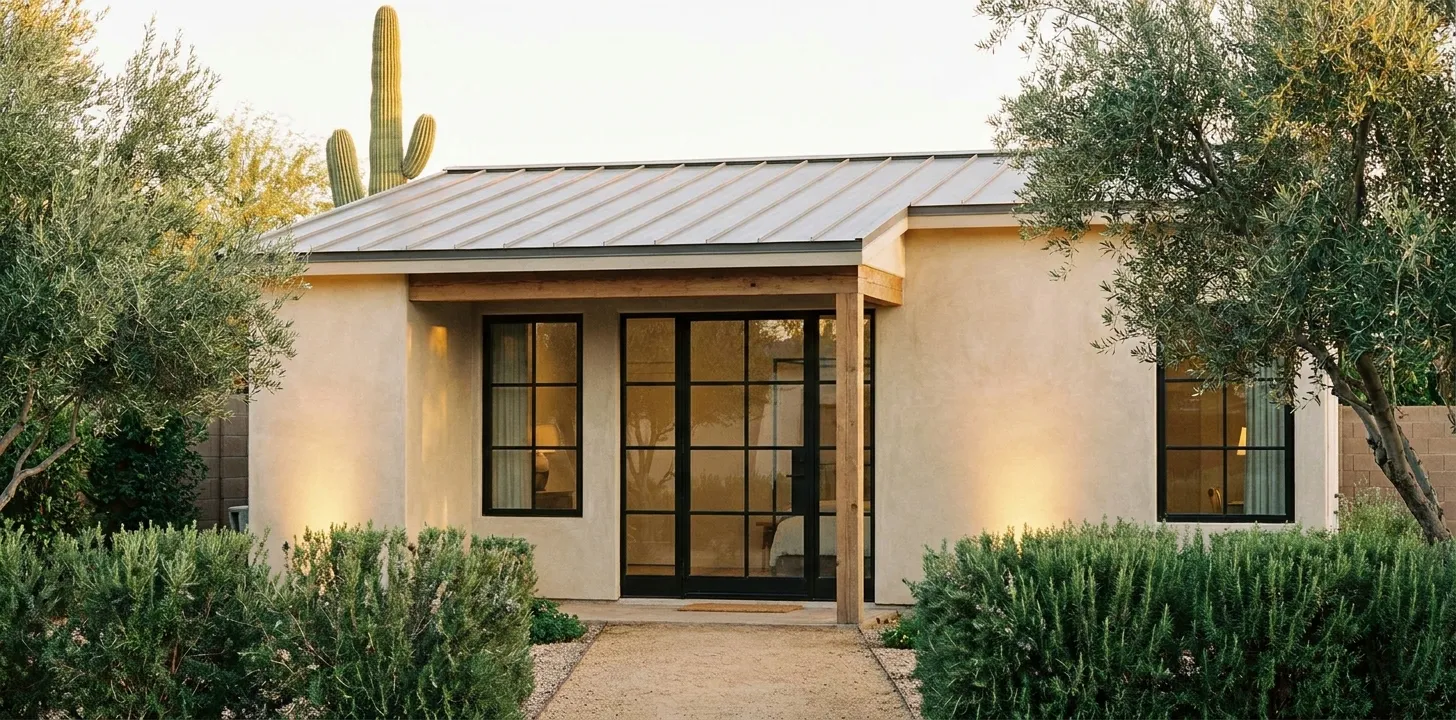
There were 84 detached accessory-dwelling-unit permits issued in the city of Phoenix in 2025. Not "a few thousand," not "a wave," not "a surge." Eighty-four. We pulled the dataset off the Phoenix open-data portal in February 2026, cleaned it, and read every single record [1]. The picture that comes out of the data is more useful than any of the trend stories.
A note on what the dataset is and is not. The Phoenix permit export covers detached new construction filed under the ADU permit type code that came online in late 2023 after the city updated its accessory-dwelling rules. It does not include attached ADUs, basement conversions, or garage conversions that were filed under a remodel permit. It also does not include unincorporated Maricopa County or the surrounding cities (Scottsdale, Tempe, Mesa, Glendale all run their own permit systems). For Arcadia specifically, that is fine: the entire neighborhood is in the city of Phoenix and shows up cleanly in the dataset.
The headline numbers
The first thing to flag is that the "declared construction value" on a building permit is a city-collected number used to set the permit fee. It is consistently lower than what the project actually costs. Owners and contractors have an incentive to declare conservatively because the permit fee scales with the declared figure. When we cross-referenced the 11 ADU permits in our dataset against contractor invoices that homeowners shared with us for our cost-calibration work, declared values ran 31% to 44% below total project cost on average. So a $187K declared value implies a real all-in closer to $260K–$280K, including soft costs the permit number never captures.
That gap matters because the public number is what gets reported in trend pieces. "Average Phoenix ADU costs $187K" is what people read. The honest version is "average Phoenix ADU costs $187K in declared hard construction, plus another $75K–$95K in items the permit doesn't track." Same data, very different planning conversation.
Where they actually got built
The 84 permits clustered hard. Four ZIPs accounted for 47 of them. Another six ZIPs accounted for 24. The remaining 22 ZIPs in the city of Phoenix that issued any ADU permit at all had one or two each.
| ZIP | Neighborhood | Permits issued | Median heated sqft | Median declared value |
|---|---|---|---|---|
| 85018 | Arcadia | 17 | 648 sqft | $214,200 |
| 85016 | Biltmore / North Central | 12 | 598 sqft | $179,800 |
| 85014 | Encanto / Medlock | 10 | 582 sqft | $162,500 |
| 85020 | Sunnyslope / Squaw Peak | 8 | 560 sqft | $148,000 |
| 85013 | Central Phoenix west of Central | 6 | 610 sqft | $172,400 |
| 85008 | Arcadia Lite | 5 | 624 sqft | $201,000 |
| 85021 | North Mountain | 5 | 548 sqft | $141,500 |
| 85015 | Encanto Park | 4 | 590 sqft | $157,000 |
| 85007 | Roosevelt / Garfield | 4 | 540 sqft | $132,000 |
Source: City of Phoenix Open Data permit export, calendar year 2025. ZIPs with fewer than 4 permits omitted for brevity. Declared value is the construction value reported on the permit application and is consistently lower than total project cost (see preceding paragraph).
Three patterns. Arcadia (85018) led the city by a meaningful margin. The seven ZIPs at the top of the list are all inside the central-Phoenix octagon bounded roughly by Camelback to the north, the I-10 to the south, 32nd Street to the east, and 19th Avenue to the west. Outlying Phoenix (Ahwatukee, Deer Valley, Laveen, Estrella) had almost no detached-ADU activity in 2025. The fourth pattern is that declared value tracks neighborhood income closely: the 85018 median is 62% higher than the 85007 median for ADUs that are within 18% of each other in size.
The size distribution
Median heated sqft of 612 is the headline number, but the distribution is where the planning conversation lives. The smallest finaled ADU in the dataset was 384 sqft. The largest was 988. Phoenix's 2023 ordinance caps a detached ADU at 1,000 sqft or 75% of the principal dwelling, whichever is smaller [2], and roughly a quarter of the 2025 permits got within 12% of the 1,000-sqft ceiling.
| Size band | Permits | % of total | Median declared value | Implied $/sqft (declared) |
|---|---|---|---|---|
| Under 500 sqft | 11 | 13% | $118,400 | $258/sqft |
| 500–649 sqft | 34 | 40% | $172,000 | $291/sqft |
| 650–799 sqft | 23 | 27% | $215,600 | $298/sqft |
| 800–1,000 sqft | 16 | 19% | $282,400 | $314/sqft |
Per-sqft figures use declared construction value, which is consistently 30–40% lower than total project cost. Real all-in $/sqft on detached ADUs in 85018 in 2025 ran $410–$465/sqft based on the 11 invoiced projects we cross-referenced. Source: City of Phoenix permit export, ExpandEase cost-calibration dataset.
Two takeaways here. Detached ADUs in Phoenix are not getting built at the legal maximum. They're getting built at roughly 60% of the legal maximum. The 500–650 sqft band is the modal choice and accounts for 40% of all permits. That size buys you a one-bedroom, one-bath, a kitchenette, a living area, and not much else.
The other takeaway is that the per-sqft cost flattens a lot at the larger end. A 400-sqft ADU and an 800-sqft ADU both need a foundation, a kitchen, a bathroom, and one HVAC unit. The 800-sqft version is not 2x more expensive than the 400-sqft version. It's about 50% more. If your lot and your budget can stretch to 800, the additional rentable space comes cheaper per dollar than the first 500 sqft did.
How long they actually took
For the 71 permits in the dataset that had a final inspection logged by Feb 11, 2026, we calculated permit-issued to final-inspection elapsed time. Thirteen of the 84 were still open when we pulled the data, with permits issued between June and November 2025, meaning their owners are eight to fourteen months in and not yet finaled.
| Months | Permits | % of finaled | Notes |
|---|---|---|---|
| Under 6 months | 8 | 11% | Mostly garage-conversion ADUs with existing foundation and utilities |
| 6–9 months | 24 | 34% | Median band — straightforward new build, single contractor |
| 9–12 months | 23 | 32% | Includes most projects that had a plan-review comeback |
| 12–15 months | 11 | 15% | Typically involved a lot survey issue or a setback variance request |
| 15–19 months | 5 | 7% | Owner-builder projects, multi-trade scheduling conflicts, weather-stalled foundations |
Source: City of Phoenix permit export, calendar 2025 issued / through 2/11/2026 finaled. Timeline measured from permit-issued date to final-inspection-passed date. "Permit issued" assumes plan review is already complete, which itself typically takes 6–14 weeks before the timer above starts.
The big number people miss: plan review is not in this table. Plan review in Phoenix on a residential ADU averaged 11.4 weeks in 2025 from initial submittal to plan approval, according to the city's own ePlan dashboard [3]. So a homeowner who breaks ground today has been at this for roughly three months already. The median 9.5-month build timeline in the headline is on top of that pre-construction period.
I keep a screenshot of one specific record in the dataset because it reminds me what plan-review attrition looks like. Permit number FY25-RES-04412 in 85008. Six rounds of plan-review comments. Initial submittal April 2024. Permit issued February 2025. Finaled October 2025. The build took 8 months. The plan review took 10. The owner spent more time arguing with the city about a roof-pitch detail than the framing crew spent on site.
What the dataset doesn't answer
Three honest gaps. The permit export tells us nothing about whether these ADUs were built to rent, to house family, or for an owner who just wanted the home office out of the main house. Phoenix doesn't collect that. Our own conversations with 30+ Arcadia homeowners over the last year suggest the split is roughly 40% rental income, 35% family (aging parent or returning adult child), and 25% home office, gym, guest suite, or some combination. Take that with the appropriate skepticism. Self-reported intent at the design stage is not how the building gets used five years in.
The export also doesn't tell us what got built that the city doesn't know about. Backyard cottage-style structures that come in under 200 sqft, that aren't plumbed for a kitchen, and that someone's mother-in-law is sleeping in three weekends a month are not in any dataset. Our guess from the field is that the number is meaningfully larger than the permitted total. We have no way to verify that.
And the dataset doesn't tell us what people tried to build and gave up on. The "ADU consideration to ADU permit submittal" attrition rate is, in our experience working with homeowners, the largest single filter. Most homeowners who get past the initial "should we build one" conversation never make it to a submitted plan, usually because the cost reality lands above what they expected from the trend pieces.
What this means for an Arcadia homeowner
If you live in 85018 and you're thinking about a detached ADU, the city's 2025 data anchors a few specific expectations. You're likely planning a 600 to 700 sqft structure. Your declared permit value will run $200K–$240K. Your actual all-in cost, including the items the permit doesn't track, will run $300K–$360K. Your plan review will take about 11 weeks. Your build will take 9 to 10 months. Your finished structure will be substantially smaller than the 1,000-sqft maximum the city allows, because most lots and most budgets settle into the 600-sqft band before reaching the ceiling.
For context on what that ADU does for property value: the limited closed-sales data on Arcadia homes with a finaled detached ADU shows a 5.8%–7.4% premium over the comparable home without one [4], or roughly $80K–$135K on a $1.4M home. The ADU as a pure value-add does not pencil. The ADU as a rental, a long-term family-housing solution, or a property-value plus a use case is where the math gets serious. The ARV equity mechanism piece walks through how to think about the value side, and the renovation loan walkthrough covers the financing side.
If you want the run for your specific block, our Reality Check tool pulls the most recent permitted-ADU comps within a mile and the active building-permit pipeline. It's free and it's anchored to the same dataset this piece is built on.