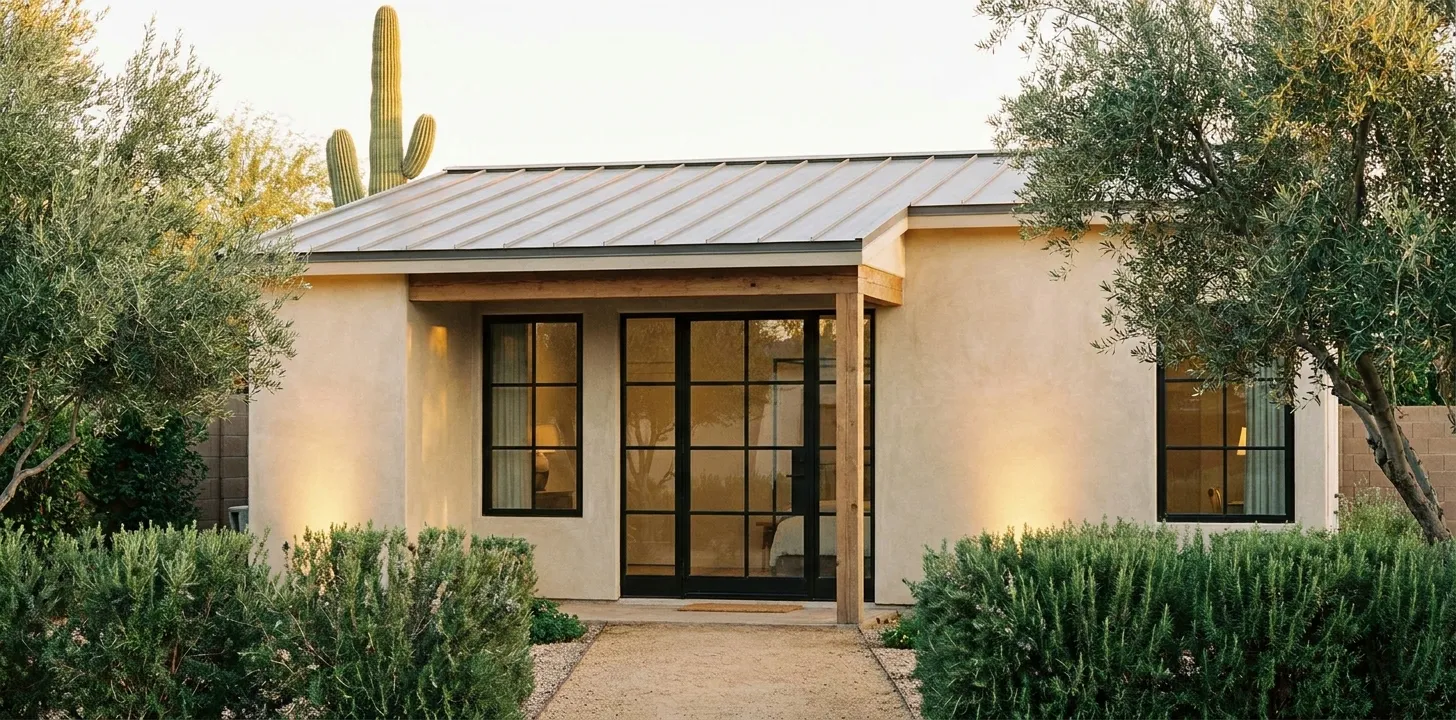
The most common question we get from Phoenix homeowners considering a guest suite isn't "how much does it cost" — it's "why are the quotes so different?" A 600-sqft guest space gets quoted anywhere from $140K to $295K depending on which of the three construction types the contractor is pricing. Attached addition, detached structure, and garage conversion are fundamentally different projects with different cost structures, different ARV impacts, and different permitting paths. Here's how to read each one.
Attached addition: $295–$430 per square foot
An attached guest suite — an addition connected to the main home sharing its foundation perimeter and roof system — is the most structurally straightforward way to add guest space in Phoenix. Cost runs $295 to $430 per square foot all-in in 2026 [1]. The low-end figure represents a single room with a half bath, value-engineered finishes, and a simple roof extension. The high end covers a full suite (bedroom, full bath, wet bar, separate entrance) with premium tile work, custom millwork, and a pocket door connection to the main living area.
The attached addition has three cost advantages over a detached structure: no sewer lateral extension (shares the main home's drain), no electrical service upgrade (shares the panel), and no stand-alone foundation — the existing perimeter footings typically extend or a simple thickened-edge slab is poured. Those three omissions save $22K–$35K vs. a detached unit of identical size.
Detached guest house: $340–$490 per square foot
A detached guest house — a freestanding structure on the same lot — costs 15–20% more per square foot than an attached addition and carries a $22K–$35K flat site premium that is independent of size [1]. The premium reflects the sewer lateral ($8K–$15K), electrical service work ($4K–$9K), and the cost of a fully independent foundation. At 600 sqft, a detached guest house runs $250K–$295K all-in in Phoenix vs. $190K–$215K for an equivalent attached addition.
The case for paying the detached premium is privacy and marketability. A detached structure with its own entrance, no shared walls, and a separate address can be permitted as an ADU — which means it can generate rental income, it shows up as an independent unit on an appraisal, and it is appraised using the income approach in addition to the cost approach. In Arcadia and other high-demand Phoenix ZIPs, a permitted detached ADU frequently appraised at $200K–$260K of added value vs. $150K–$180K for an attached addition of equivalent size.
Garage conversion: $180–$310 per square foot
Converting an existing attached or detached garage into a guest suite is the lowest cost-per-sqft option in Phoenix. Cost runs $180 to $310 per square foot depending on existing conditions [1]. An attached two-car garage conversion (440 sqft) typically runs $80K–$140K all-in — the existing slab is usable in most cases, the roof is already in place, and MEP runs connect to the main home. The ceiling is low because the space already exists.
The catch: garage conversions do not add to heated square footage for appraisal purposes unless the conversion meets all habitability code requirements, which in Phoenix means minimum ceiling height (7'6"), insulation to residential R-values, and code-compliant egress. Many older Phoenix garages have 8' ceilings (acceptable) but inadequate insulation and non-standard door/window rough openings that add $15K–$25K to bring up to residential standards. The ARV impact is also weaker than a true addition: appraisers typically apply a 40–60% value factor to converted garage space vs. purpose-built additions, limiting manufactured equity.
| Attached Addition | Detached Guest House | Garage Conversion | |
|---|---|---|---|
| Cost/sqft (premium) | $295–$430 | $340–$490 | $180–$310 |
| 600 sqft all-in | $190K–$215K | $250K–$295K | $110K–$190K |
| Site utility premium | None | $22K–$35K | None (if attached) |
| ARV per sqft (Arcadia) | $530–$570 | $520–$560 | $280–$350 |
| Manufactured equity (600 sqft) | $115K–$140K | $90K–$120K | $25K–$80K |
| Permit as ADU / rentable | Rarely (no privacy) | Yes — full ADU permit | Sometimes (code-dependent) |
| Permit timeline | 60–90 days | 90–150 days | 45–75 days |
All figures Phoenix 2026, premium quality baseline. ARV per sqft reflects Arcadia and comparable high-equity Phoenix ZIPs; other ZIPs will differ. Manufactured equity = ARV gain minus build cost at midpoint.
Zoning: what Phoenix actually allows
Phoenix updated its ADU ordinance in late 2023, allowing up to two detached ADUs on any single-family lot. There are no minimum lot size requirements for ADUs in Phoenix (unlike Scottsdale and many other Valley cities), and the city released a library of pre-approved ADU standard plans in 2025 that reduce architectural fees [2]. Setback requirements: 5' from rear property line, 3' from side property line for detached units under 800 sqft. Over 800 sqft, standard residential setbacks apply.
HOA restrictions are separate from city zoning and in some Arcadia-adjacent neighborhoods are more restrictive than city code. Most Arcadia lots are not in an HOA — it's a subdivision of the city, not a master-planned community. If you're in one of the few Arcadia HOAs, verify the CC&Rs before pricing any detached structure.
Financing your guest house addition
The standard financing path for a Phoenix guest house addition is an ARV renovation loan — a construction-to-permanent product that lends against the completed appraised value of the property including the new structure, not just current equity [3]. This matters because a detached guest house in Arcadia that costs $250K to build and adds $230K of appraised value would require $250K of existing equity under a traditional HELOC. Under an ARV loan, you're borrowing against the $230K of new value — the equity you're creating with the project.
Monthly payment on a $220K ARV loan at 7.5%, 30 years: approximately $1,540/month. If the guest house generates $1,800–$2,100/month in rental income, the structure pays for itself in operating cash flow within 3–5 years depending on occupancy.