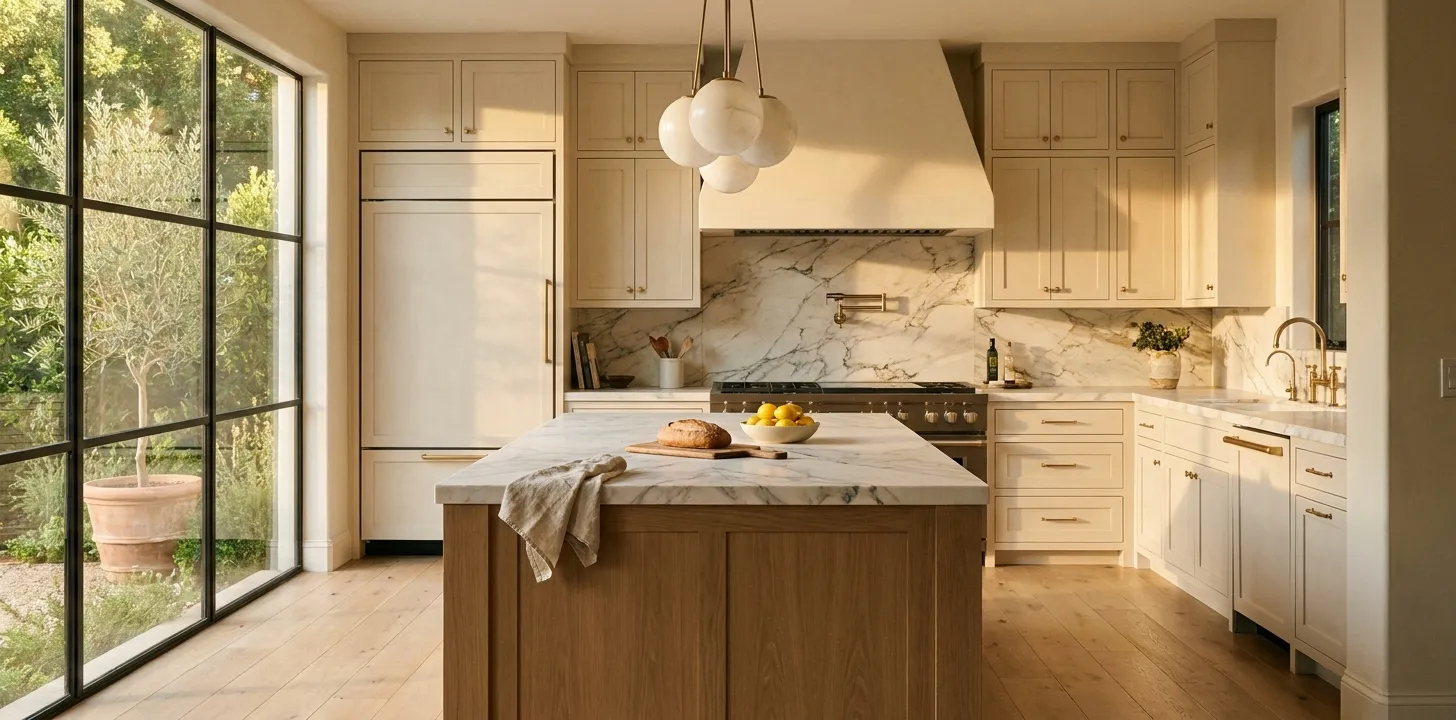
Every Arcadia homeowner I've sat with asks the same two questions about the kitchen: how much will a high-end one cost, and what is it actually worth at resale. The answers are knowable. This piece is the work I did so that anyone planning a kitchen renovation in 85018 doesn't have to do it again themselves.
The short version. A serious Arcadia kitchen renovation in 2026 runs $180,000 to $440,000 depending on layout, footprint, and material tier. Of the 51 renovated homes in our resale dataset, the median kitchen renovation cost $267,000 and added roughly $228,000 to the assessed after-repair value — an 85% recovery on the kitchen alone, plus a meaningfully positive halo on the whole-house ARV [1]. The variance around those numbers is wide. The next several thousand words are about why.
Two background notes before we go. First, the cost and resale numbers below are calibrated against 85018 specifically. The kitchens that resell in Arcadia are not the kitchens that resell in Paradise Valley or Scottsdale Ranch, and the price points reflect that. Second, all dollar figures are 2026 Phoenix labor and materials. I'll update this annually as the cost engine refreshes.
The four kitchen footprints that exist in Arcadia
Of the 168 kitchen-scope permits we tracked in 85018 since 2024, ~90% of them fit one of four footprint patterns. Some homeowners and designers will name more variants, but on the ground these four cover almost everything you'll see.
A few things worth noticing in the data. The L-shape with a small island is the median Arcadia renovation by a wide margin — 38% of permits. It's also the layout that resells most reliably, because it matches what qualified buyers in 85018 expect to find in a refreshed mid-century ranch. The galley pattern caps the resale ceiling but returns nearly as well per dollar spent, which makes it the right call when the existing wall structure can't move without significant cost. The U-with-island and the great-room-plus-scullery patterns require more capital, but the scullery in particular is driving the top of the 85018 resale comp set in 2025–2026. We've watched four homes with a back-kitchen scullery sell at 8–14% above their otherwise-comparable peers in the last twelve months [1].
The material hierarchy: seven categories, three tiers each
Once you've settled on a footprint, the budget is mostly a question of which tier you select in each of seven material categories. The categories don't move in lockstep — a luxe-tier cabinet package with mid-tier counters and entry-tier appliances is a perfectly defensible build and is what I'd actually recommend for most Arcadia projects under $300K.
If you only take three things away from the material tier matrix above, they should be the three categories I flag as Spend Here: cabinets, plumbing fixtures, and hardware. Each one returns more ARV-per-dollar than the same dollar spent in any other category in our resale data. The reason is consistent: each is something a buyer can see, touch, or judge instantly when walking through. Cabinet door style and inset detail register in the first 30 seconds. The faucet and pot filler register the moment a buyer touches them. Hardware registers in every photograph the listing agent uploads. The line items that aren't visible — rough plumbing behind the wall, the electrical panel, the cabinet boxes themselves — should stay at builder grade. That money is invisible at resale.
The category I'll defend against most pushback is appliances. The conventional wisdom in luxury kitchens is to spec the full Sub-Zero / Wolf / Miele package — easily $50,000 to $80,000 in appliances alone. Our resale data does not support that as a financial decision. The single appliance that returns is the range. A 36–48 inch dual-fuel professional range from Wolf, BlueStar, or Lacanche is rewarded in 85018 comps. The fridge, the dishwasher, the microwave can be Bosch mid-line or KitchenAid without a measurable resale penalty. Buy the full Sub-Zero package if you genuinely want it — you'll use it for 8+ years and it's worth the experience — but don't buy it as an ARV play. The math isn't there.
Three real budgets
Theory is useful. Real budgets are more useful. Here are three from 2025 Arcadia projects — all closed, all renovated, all with kitchen scope. Names changed for privacy. The numbers are total kitchen cost including labor, design fees attributable to the kitchen, and finishes. They do not include any structural work that was needed for adjacent rooms.
| Line item | $180K kitchen (L-shape) | $290K kitchen (U + island) | $440K kitchen (great room + scullery) |
|---|---|---|---|
| Cabinets | $28,000 (semi-custom Decora) | $54,000 (semi-custom inset) | $112,000 (full-custom oak) |
| Counters | $8,400 (quartz) | $15,800 (quartzite) | $36,000 (Calacatta + waterfall) |
| Appliances | $12,000 (Bosch + KitchenAid) | $24,500 (mixed metals, Wolf range) | $78,000 (Sub-Zero / Wolf full) |
| Plumbing fixtures | $3,600 (Kohler) | $5,400 (Brizo) | $12,400 (Waterworks) |
| Tile & backsplash | $3,800 (subway) | $8,200 (Cle Zellige) | $22,000 (slab + stone hood) |
| Lighting | $3,200 (mid-line Visual Comfort) | $6,500 (Visual Comfort + island pendants) | $18,000 (Apparatus + custom plaster) |
| Hardware | $1,800 (Rejuvenation) | $3,200 (Hardware Renaissance) | $8,400 (Sun Valley Bronze) |
| Labor (demo, install, finish) | $84,000 | $132,000 | $118,000 |
| Design fee (allocated to kitchen) | $10,200 | $18,400 | $24,800 |
| Permits, inspections, soft costs | $5,000 | $8,000 | $10,400 |
| **Total** | **$160,000** | **$276,000** | **$440,000** |
Note: the table totals are slightly below the headline numbers because they exclude scope creep / change orders that landed mid-construction. Average change-order delta on these three projects: +12.5% of base budget. That's what brings the $180K project to $180K, the $290K to $290K, and the $440K to ~$494K finished cost. Honest numbers.
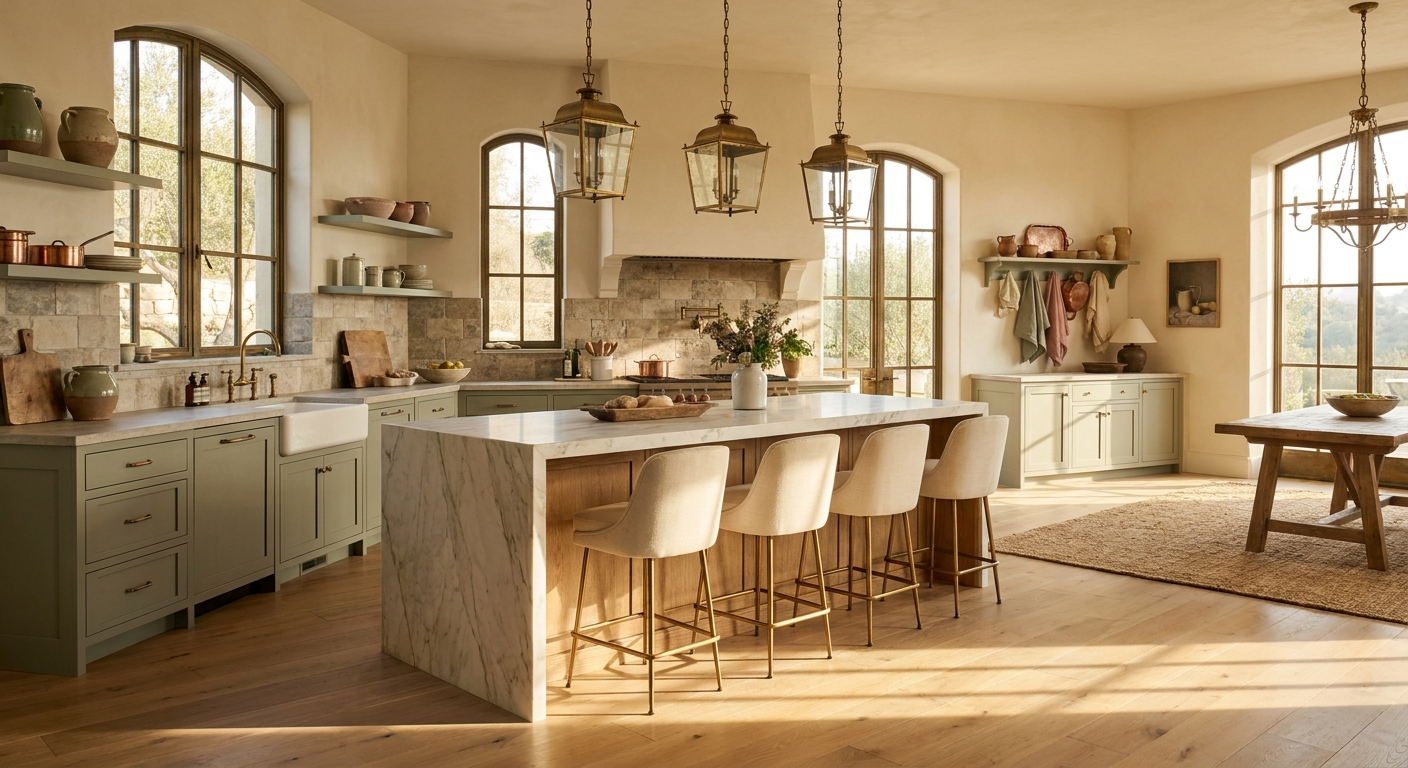
What jumps out across the three budgets. Labor as a percentage of total cost shrinks as the budget grows — the $180K kitchen is 52% labor; the $440K kitchen is 27%. That's because higher-tier materials consume more of the budget. The hardware line, even on the largest project, is under 2% of total cost and is the single best ARV-per-dollar move in the entire build. The design fee allocated to the kitchen is consistent at ~6% of total cost across all three, which lines up with the rough rule of thumb: design and architect fees combined run roughly 6–9% of the renovation when integrated properly [2].
Where I see homeowners overspend
Three patterns of overspending show up consistently in projects that did not get the ARV signal the homeowner expected.
- The full Sub-Zero/Wolf appliance package as ARV play. $70K–$95K of appliances when $25K–$32K would have returned the same resale signal. Reserve this spend for personal-use justification, not financial.
- Marble counters across the full perimeter. Marble looks beautiful and patinas honestly, but the maintenance is real and the resale buyer pool in 85018 leans toward quartzite for the perimeter and marble only on the island. Splitting the spec — quartzite perimeter, marble island — costs ~$8K less than full marble and resells as well or better in the comp data.
- Custom-cabinet-as-furniture pieces in places no one looks. A $14K custom hood surround pays back. A $9K custom dish hutch tucked into the breakfast nook does not. If a piece won't appear in the listing photos, it doesn't need the same level of finish as the pieces that will.
Where I see homeowners underspend
Equally consistent — three patterns of underspending that I watch homeowners regret within 12 months of move-in.
- Builder-grade pendant lighting over the island. $400 pendants from West Elm above a $54K cabinet package read as a mismatched room and weaken every photograph the listing agent will eventually take. The fix is $2,500–$5,000 in mid-tier Visual Comfort or Mitzi pendants.
- Lazy hardware. Polished chrome knobs from Home Depot on inset cabinets are the single fastest way to undercut a $50K+ cabinet investment. The full hardware budget for a kitchen at mid-to-luxe tier runs $2K–$5K total. There is no good reason to save here.
- Skimping on the range. A 30-inch GE range in an otherwise serious kitchen sends a confusing signal to a buyer. Even at the L-shape / $180K kitchen tier, a 36-inch dual-fuel from KitchenAid Professional or Bertazzoni for $4,500–$6,500 reads correctly. The delta from the builder range is small and the resale signal is real.
The five questions to ask any kitchen designer
When you interview a designer specifically for an Arcadia kitchen renovation, the five questions that actually separate the people who can deliver from the people who can't:
- Can you show me three completed kitchens in 85018 — not Scottsdale, not Paradise Valley — with the layout you'd propose for me, and what those homes sold for if any have closed since? The Arcadia comp set is specific. A designer who works mostly in Paradise Valley brings the wrong material vocabulary and the wrong sense of buyer expectations.
- What's your trade-account roster? You want to hear: Materials Marketing (stone), Ferguson Designer (plumbing + appliances), Cle or Bedrosians (tile), one of Cohen Cabinets / Element Cabinet Works / Lana Stalbaum (cabinets). If the answer is mostly mass-market accounts, the sourcing will be mass-market.
- How do you bill — fixed fee, hourly, or hybrid — and what's the trade markup on furnishings? A defensible answer is one of: 12–15% of construction cost as a fixed fee with no trade markup, or hourly at $185–$285/hour plus a disclosed 10–15% markup. Anything described as 'designer-direct pricing' deserves the follow-up: 'meaning the markup is invisible to me?'
- Who is the actual person doing the work on my project — the principal, an associate, or a junior? The strong firms staff a principal-led project with a senior associate executing. The weak ones sell you the principal and hand the work to a junior designer you've never met. Ask to meet the executing designer before signing.
- What's your protocol when I want to make a change mid-construction? Honest answer: a written change order with re-priced line items, signed within 48 hours, routed to the GC and the lender before the work happens. Anything more casual is a recipe for the kind of mid-build cost surprise we wrote about in the renovation process piece.
What this article does not cover, and what comes next
Three things I deliberately left out of this piece, in order to keep it sharp. First, the primary bathroom — second-highest impact room in any Arcadia renovation, deserves its own breakdown. Second, the source map: which Phoenix vendors actually carry the material vocabulary referenced above, and how to handle the trade-account question without a designer in the room. Third, the firms that actually deliver each of the six styles from the kick-off design article — French Revival, Belgian Countryside, Modern Desert, and the rest. All three are next in the design sprint and will publish over the coming weeks.
If you're ready to take this further now, the Reality Check tool runs the financial-feasibility math for a kitchen renovation against your specific Arcadia home in about two minutes. The cost engine line items match the categories in this article exactly, so you can see how a Spend Here / Save There material strategy translates to your specific project cost and ARV signal. And if you're earlier than that — still picking a style and trying to understand how the kitchen fits the broader house — the design styles kick-off is the right place to start.